
Breaker Keeps Tripping in Fort Pierce? Safe Troubleshooter
Breaker tripping troubleshooter for Fort Pierce, FL: safe steps for a tripping breaker near 34951 or Downtown Farmers Market, with hard stops for burning smell, sparks, heat, or water, with safe steps in order and clear stop points for every home.
Open 24 hours a day, 7 days a week.
Your answer, in plain words
Answer three questions about a tripping breaker, and this guide gives safe steps in order, or a clear stop-and-call result if any danger sign applies. It never tells you to open a panel or work on live wiring. Call us if you are unsure at any point.
Use the tool
Why breakers trip
A breaker trips to protect the circuit: too much load on one circuit, a faulty appliance, a short, or a ground fault can all trip it. The trip itself is the protection working, not the problem. The problem is whatever caused it, and finding that cause is the job. That is why the safe rule is one reset, not repeated resets: each extra reset risks heat and damage if the fault is still there.
Need an electrician in Fort Pierce?
The one-reset rule, explained
Unplug everything on the tripping circuit first, so the reset tests the circuit, not the appliances. Push the breaker fully off, then on, once. If it stays on, plug items back one at a time and note which one trips it: that item is the first suspect. If it trips again at once with nothing plugged in, the fault is in the circuit or panel, so leave it off and call us.
What never to do with a tripping breaker
Never tape over a breaker, never swap in a larger breaker to stop tripping, and never feed a dead circuit from another room. Never open a panel, never touch wet parts, and never pour water on an electrical fire. If you are unsure at any point, stop and call (772) 218-3629. See our electrical repair service, our panel upgrade service, our GFCI outlet installation service, Fort Pierce South, and the full tools hub.
Need an electrician in Fort Pierce?
What your result means
Your result sorts your trip into one of three actions, and the action matters more than the cause at this stage. Stop means leave the circuit off and call at once. Call means do not reset again. One reset means a single careful test, then a call if it trips again.
Stop result: leave it off and call now
A stop result means a danger sign is present, or the breaker trips the instant it is reset. Keep the circuit off, keep everyone away from the panel, and do not open the panel or touch anything wet. If there is fire or smoke, call 911 first, then call us at (772) 218-3629 once you are safe. A stop result never turns into a reset step later in the day: the circuit stays off until we inspect it. This is the right result for burning smells, sparks, heat, scorching, buzzing, and water near the panel, and for any trip that returns the moment the breaker is switched on.
Call result: do not reset it again
A call result means the breaker has already tripped more than once, or the pattern points to a circuit fault rather than a one-off overload. Leave it off, note the room and what was running, and call (772) 218-3629 for a visit. We trace the fault from the panel outward, checking the circuit, the outlets on it, and the appliances that were connected. If the dead circuit feeds a refrigerator, a medical device, or a security system, say so on the call so we can judge urgency. See our emergency electrician service and our electrical repair service for what a visit covers.
One-reset result: a single careful test
A one-reset result means no danger sign applies and the breaker has not already been reset repeatedly. Unplug everything on that circuit first, push the breaker fully off and then on, once only, and watch what happens. If it stays on, plug items back one at a time and note which one trips it. If it trips again at once, or trips again later the same day, stop there and call us: the result has become a call result. Never tape a breaker, never fit a larger breaker to stop tripping, and never work on live wiring.
Seven breaker scenarios, explained
The pattern of the trip tells us where to look first, so matching your pattern before you call saves time on the visit. Instant trips, trips under load, buzzing, heat, water, storm trips, and new-appliance trips each point to a different fault, and only some of them allow a single reset.
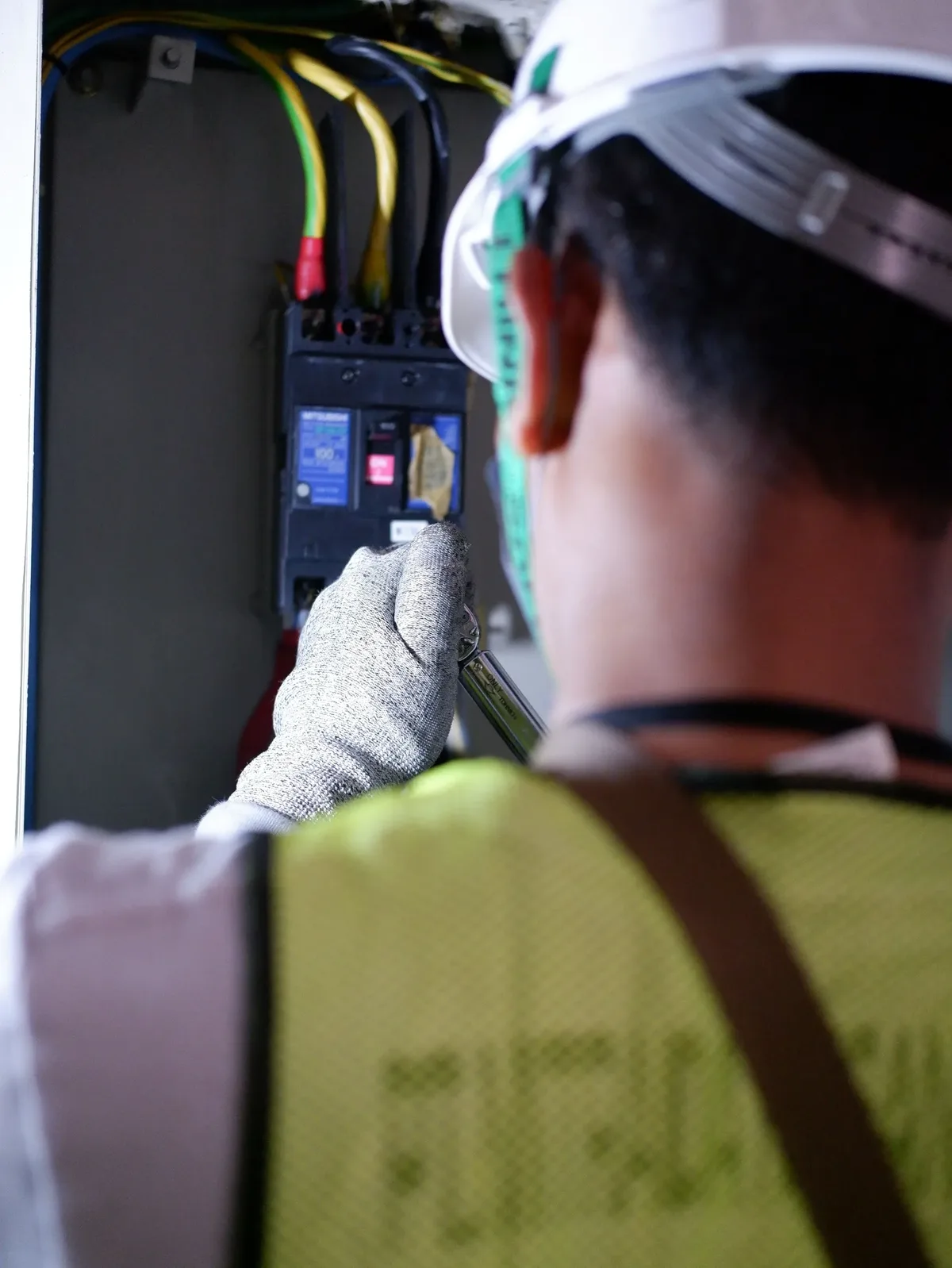
Trips instantly on reset
When a breaker trips the instant it is switched on, with nothing plugged in, the fault is almost certainly in the circuit or the panel itself, not in an appliance. This is a stop result: leave the breaker off and call us. Repeated resets in this state risk heat and damage, and they tell us nothing new after the first instant trip. Note whether the trip is instant every time, or only sometimes, and whether any outlet or switch on that circuit looks scorched or feels warm.
Trips under load
A breaker that holds with little running but trips when several things run together is usually an overloaded circuit. Heaters, hair dryers, kettles, air conditioners, and microwaves draw heavily, and two of them on one circuit can be enough. The safe test is the one-reset rule with everything unplugged first, then items added back one at a time. If the same combination trips it twice, the circuit needs a proper fix, not a bigger breaker: that may mean a dedicated circuit, which we discuss on our panel upgrade service page and our outlet and switch installation service page.
Buzzing, heat, or a hot panel or outlet
Buzzing, a hot breaker, a hot outlet faceplate, or a warm panel cover are all hard stops. Do not reset, do not touch the hot part, and do not open the panel. Heat means a connection is failing or a breaker is not seating properly, and buzzing can mean arcing inside a device or connection. Keep the circuit off, keep the area clear, and call (772) 218-3629. If you smell burning or see smoke, call 911 first. These symptoms stay hard stops even if the breaker seems to hold after a reset.
Water near the panel or an outlet
Water and electricity do not mix, and a wet panel, wet outlet, or damp wall around electrical gear is a stop result. Do not touch wet parts, do not stand in water near the panel, and do not reset the breaker. In Fort Pierce this pattern often follows a storm, a plumbing leak, or a pool or outdoor circuit exposed to rain. Tell us where the water came from and how far it spread, and keep the circuit off until we inspect it. Wet circuits must stay off until inspected, even if they look dry later.
Trips after a storm
A trip after a storm can mean several things at once: a surge, water entry, or a damaged outdoor circuit. First, check for the hard stops: burning smell, heat, buzzing, or water. If any apply, stop and call. If none apply and the breaker has not already been reset repeatedly, the one-reset test applies, but watch the circuit closely afterwards. Storm trips that repeat, or that come with flickering elsewhere in the home, point to wider damage worth an electrical inspection. For storm readiness, see our storm outage checklist and our surge protection checker.
Trips when a new appliance runs
A new appliance that trips a breaker on its first run may be faulty, or it may simply overload a circuit that was already near its limit. Note the appliance, the room, and what else was running, and do not keep resetting to test it. If the appliance trips a different circuit as well, the appliance is the likelier suspect; if only one circuit trips, the circuit is. A dedicated circuit is the usual fix for a heavy new appliance, and our panel upgrade service page explains how we judge that. If the appliance smells burnt or the outlet feels hot, treat it as a stop result.
Safe one-reset flow
- Check for hard stops: burning, sparks, heat, buzzing, or water. If any apply, stop and call.
- Unplug everything on the tripping circuit.
- Push the breaker fully off, then on, once only.
- If it stays on, plug items back one at a time and note which one trips it.
- If it trips again at once, leave it off and call (772) 218-3629.
Reset once or call: the comparison
| Situation | Reset once | Call, do not reset |
|---|---|---|
| Single trip, no danger signs, nothing already reset repeatedly | Yes, with everything unplugged first | Call if it trips again after that one reset |
| Trips instantly on reset | No | Yes, leave the circuit off |
| Buzzing, heat, sparks, scorching, or burning smell | No, never | Yes, at once; 911 first for fire or smoke |
| Water near the panel or an outlet | No, never | Yes, keep clear of wet parts |
| Already reset more than once today | No, the one reset is used up | Yes |
| Trips under load with a known heavy combination | Yes, once, testing items one at a time | Yes, if the same combination trips it again |
| Trips after a storm with no danger signs | Yes, once, then watch closely | Yes, if it repeats or flickering appears elsewhere |
Tripping breakers in Fort Pierce homes
Fort Pierce homes trip breakers for local reasons as well as ordinary overloads, and the address helps us judge which pattern fits. Salt air corrodes outdoor panels and connections, summer air-conditioning loads run hard, and storm water finds its way into outdoor gear, especially near the coast and the inlet.
Where local patterns show up
Homes on Hutchinson Island and in South Beach face the hardest salt-air exposure, so outdoor panels, pool circuits, and exterior outlets corrode sooner and trip sooner. Inland homes in Fort Pierce North, Fort Pierce South, Lakewood Park, and White City more often trip under summer air-conditioning load, or when a new appliance joins an already busy circuit. Older homes near Downtown Fort Pierce may trip because the original circuits were never sized for modern loads. We serve the verified ZIP codes 34945, 34946, 34947, 34949, 34950, 34951, 34981, and 34982, and we confirm coverage for your exact address on the call, including homes near Fort Pierce Inlet State Park and the Downtown Farmers Market area.
Your serving utility, checked per address
Fort Pierce Utilities Authority (FPUA) serves city addresses, while Florida Power and Light (FPL) serves addresses outside the city, and the boundary is checked per exact address, not guessed from the neighbourhood name. That matters when a trip affects the whole home rather than one circuit: a whole-home outage may be a utility outage, while a single tripped circuit is your panel doing its job. If neighbours have power and you do not, or only one room is dark, the panel is the likelier place to look. If the whole street is dark, check with your serving utility first, then call us if power returns but a breaker will not stay on.
Before you call checklist
- Which room or rooms lost power, and which breaker sits between on and off.
- What was running when it tripped: air conditioner, heater, kettle, hair dryer, or a new appliance.
- How many times the breaker has already been reset today.
- Any burning smell, sparks, heat, buzzing, scorching, or water, and where exactly.
- Whether the trip followed a storm, and whether flickering appears elsewhere in the home.
- Your ZIP code and nearest landmark, so we can confirm your serving utility and coverage.
What to tell us when you call
A short, clear description on the call helps us arrive ready, and it costs you nothing to gather before you dial. Note the room, what was running, how many times the breaker has tripped, and any smell, heat, buzzing, or water, then call (772) 218-3629 and read that note back to us.
How the visit works
Fort Pierce Electric Pros is open 24 hours a day, 7 days a week, with same-day service, 23 years of experience, licensed and insured, and Master Electrician Certification. On the visit we test the circuit, check the panel and the outlets on that circuit, and find whether the cause is the breaker, the wiring, or an appliance. We explain what we found in plain words before any work starts, and we leave the circuit safe even if a larger fix needs a follow-up visit. If the panel itself is the problem, see our panel upgrade service and our Federal Pacific panel replacement service; if damp or outdoor circuits are involved, see our GFCI outlet installation service. For a wider safety check, use our emergency triage quiz.
When not to wait
Do not wait until morning if there is a burning smell, sparks, heat, buzzing, water near the panel, or a breaker that trips instantly on reset. Those are call-now patterns, day or night, because the fault can worsen while the circuit stays live. If the trip is a single overload with no danger signs and the one reset holds, a same-day visit is still worth booking, because a circuit that tripped once under load will usually trip again under the same load. Call (772) 218-3629 at any hour: we are open 24 hours a day, 7 days a week.
Frequently asked questions
Why does my breaker keep tripping in Fort Pierce?
The usual causes are an overloaded circuit, a faulty appliance, a short, or a ground fault. A breaker that trips once after a heavy load is different from one that trips at once on reset: the second pattern means a circuit fault, so leave it off and call (772) 218-3629.
Can I reset a tripped breaker myself?
You may try once, but only with no burning smell, heat, buzzing, water, or scorching. Unplug everything on the circuit first, push the breaker fully off, then on. If it trips again at once, leave it off and call an electrician.
What should I unplug before resetting a breaker?
Everything on that circuit: heaters, hair dryers, kettles, air conditioners, and any large appliance that was running. Resetting with the load still connected cannot tell you whether the circuit or an appliance caused the trip. Heaters, kettles, and air conditioners are the usual suspects to test first.
Is it safe to tape a breaker so it stays on?
No. Taping a breaker, or fitting a larger breaker to stop tripping, defeats the protection and can overheat wiring and start a fire. A breaker that will not stay on is warning you about a fault, so leave it off and call us. Damaged or wet circuits must stay off until inspected.
What does it mean if only one room loses power?
It usually means one circuit has tripped, rather than a whole-home outage. Check the panel for a breaker sitting between on and off, and note the room and what was running. If the breaker will not stay on, leave it off and call us.
When should a tripping breaker be treated as an emergency?
Treat it as urgent if there is a burning smell, sparks, heat, scorching, buzzing, or water near the panel, or if a breaker trips the instant it is reset. Keep clear, leave the circuit off, and call (772) 218-3629 at once, or call 911 first for fire or smoke.
Ready to talk?