
EV Charger Installation for Condos and HOAs in Fort Pierce
EV charger installation condo HOA Fort Pierce owners ask about starts with the building, not the charger: the law, the board’s rules, and the panel all decide what can be fitted. In Hutchinson Island and Downtown condos, ZIP 34949 and 34950, start with your parking space and the load calculation.
Call Now to Speak to a Specialist
Open 24 hours a day, 7 days a week.
EV charger installation condo HOA Fort Pierce work is a two-part job: permission first, then power. Florida law stops a condo board banning a charger in your own designated parking space, but the board can still set conditions, and the building’s panel may need a load calculation before anything is fitted. Exact price is confirmed on the call.
What Florida law says for condo owners
Florida Statute 718.113(8), the Condominium Act’s charging-station provision, says a declaration of condominium or a restrictive covenant may not prohibit — or be enforced so as to prohibit — a unit owner from installing an electric vehicle charging station within the boundaries of the unit owner’s limited common element or exclusively designated parking area. The board of administration may not prohibit it either. The provision has been in force since 2018, and it covers the owner’s own space — not a general common-area space shared with everyone.
The same subsection sets the conditions. The installation may not cause irreparable damage to the condominium property. The electricity must be separately metered or metered by an embedded meter and paid for by the unit owner who installs it, or by a successor. The installing owner is responsible for the costs of installation, operation, maintenance and repair, including hazard and liability insurance, and for the cost of removal if the station is no longer needed. The installation must also comply with all federal, state and local laws.
The statute also gives the owner an implied easement across the common elements for the installation and the supply of power, including any necessary equipment. That easement is what lets the cable run from the building’s panel to a space that is not next to it — but it does not remove the conditions above, and it does not cover a space that is not the owner’s own designated parking area.
What your association can still require
The right is not a blank check. Under section 718.113(8)(h), the association may require the owner to comply with bona fide safety requirements consistent with building codes or recognized safety standards; to comply with reasonable architectural standards on the dimensions, placement or external appearance of the station, provided those standards do not prohibit the installation or substantially increase its cost; to engage a licensed and registered firm familiar with electric vehicle charging station installation; to provide a certificate of insurance naming the association as an additional insured within 14 days of approval or notice; and to reimburse the association for any increased insurance premium attributable to the station within 14 days of the invoice.
Associations can also ask for plans, information and approvals beyond the statute’s list. A Florida appeals court has treated reasonable requirements beyond the five statutory conditions as lawful, and an owner installation that alters common elements can in some circumstances be treated as a material alteration needing the approval route in the governing documents. That is why the first step is reading your own declaration, not assuming the statute settles everything. This guide is general information, not legal advice; a Florida attorney answers the position for a specific building.
Wondering whether your building allows a charger?
HOAs are a different question
The written right-to-charge law sits in the Condominium Act, Chapter 718. Homeowners’ associations are governed by Chapter 720, and the HOA statute we checked — section 720.3075, 2025 text — contains no equivalent electric vehicle charging provision. Some summaries online describe a newer change extending the same protection to HOA parcel owners; we have not verified that change in the statute text, so this guide does not rely on it.
For an HOA community, the answer turns on your own declaration of covenants, articles and bylaws: some allow a charger in a deeded or assigned space with conditions, some restrict it, and some say nothing at all. Read the documents first, then call — the electrical side, capacity, metering and the cable route, is the same job either way, and the visit confirms what your community allows before anything is fitted.
The electrical side: capacity, metering and the cable run
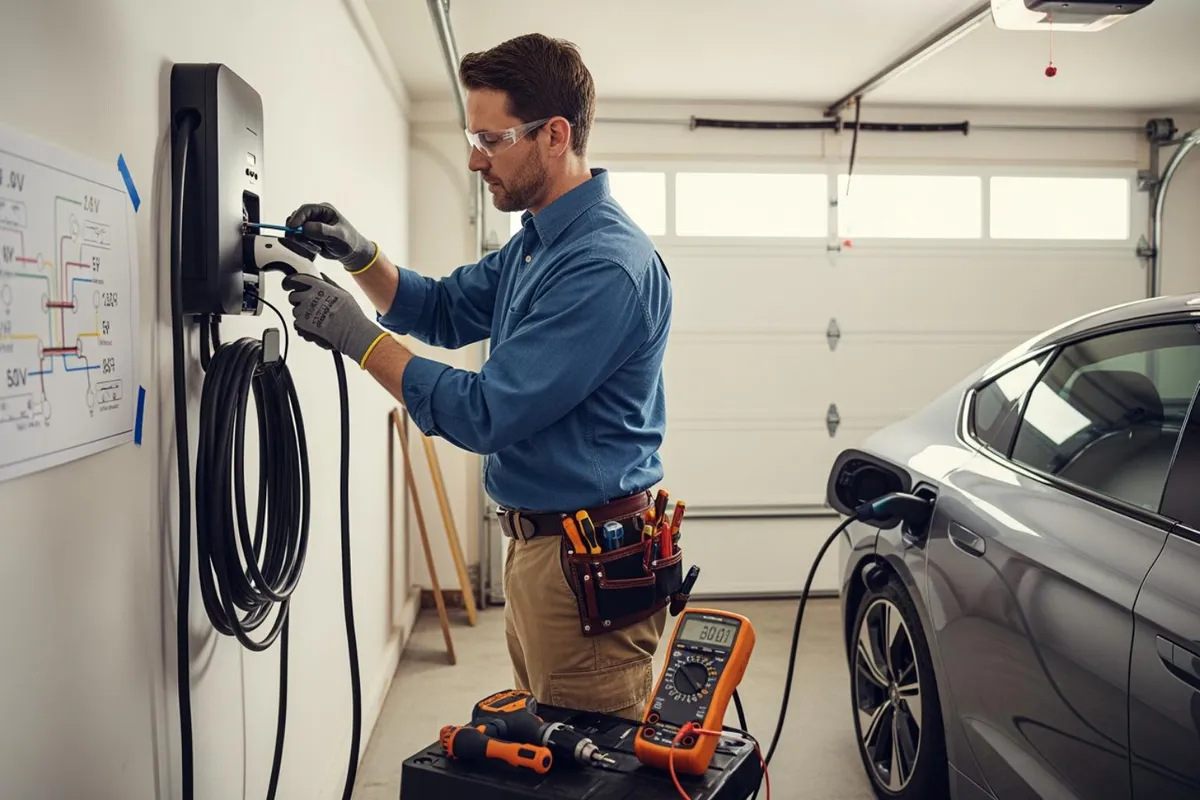
Permission is only half the job. The visit starts with a load calculation: the building’s service, the panel that feeds your space, and the other loads already on it decide whether a Level 2 charger on a dedicated 240-volt circuit fits, or whether the answer is a smaller charger, load management, or service-side work. EV charger installation condo HOA Fort Pierce work often turns on distance: the cable run from the panel to a garage or carport space, through common walls or across common elements, is usually the biggest part of the job.
Metering is a legal requirement as well as a practical one: the statute requires the charger’s electricity to be separately metered or metered by an embedded meter, paid for by the installing owner. Outdoor runs in Fort Pierce need weatherproof, salt-air-resistant equipment — Hutchinson Island garages and carports sit in salt air, and a charger fitted for an inland garage will not last the same way. The permit and inspection route is confirmed on the call for the exact job, not assumed. Our EV charger panel capacity guide explains how the load calculation settles the question, and our EV charger installation page covers what a standard fitting involves.
Your own space, or a charger the association runs
There are two shapes of condo charging. The first is your own station in your own designated space, under section 718.113(8) — you pay for it, it is metered to you, and you carry the insurance. The second is a station the association installs and operates on the common elements under section 718.113(9): the board may make one available and set the charges or manner of payment for owners, residents or guests who use it, and that installation does not count as a material alteration or substantial addition to the common elements.
The two shapes answer different questions. Your own station gives you a charger that is always yours, on your meter. A shared station needs no work in your space, but you share it, pay the association’s rate, and wait your turn. The visit can scope either one: EV charger installation condo HOA Fort Pierce work starts from the same place in both cases — the load calculation and the cable route.
Own space or shared charger — which fits your building?
What to have ready before you call
The call goes faster with five facts: whether your parking space is a limited common element or an exclusively designated space, which your declaration states; what your declaration and any board rules say about chargers; the size of the panel that feeds the space and how many spare breaker spaces it has; the distance from that panel to the space; and the charger model you have in mind, if any. With those answers, the call ends with a clear scope.
The visit then covers the load calculation, the cable route and the metering, the charger placement and the salt-air rating, and the permit and inspection steps for the exact address. Our licensed electrician guide explains how to check a contractor before hiring, and our rental property EV charger guide covers the permission-first pattern for tenants and landlords.
Cost factors, not a price
The price moves on the cable run, the panel capacity, the metering, the charger model, and the permit and inspection route — a short run from a panel beside the space is a different job from a long run through common walls to a distant carport. No single Fort Pierce figure fits every building, so the honest answer is the factors and a call. The visit ends with a written price for the job as scoped, and the exact figure is confirmed on the call. Our EV charger cost factors guide covers the factors that move a standard home installation, and our Tesla Wall Connector page covers the most common charger fitted in Fort Pierce condos.
EV Charger Installation for Condos and HOAs in Fort Pierce: frequently asked questions
Can my condo association stop me installing an EV charger in Fort Pierce?
No — not by banning it outright. Under Florida Statute 718.113(8), a declaration of condominium or a restrictive covenant may not prohibit a unit owner from installing an electric vehicle charging station within the boundaries of the unit owner’s limited common element or exclusively designated parking area, and the board may not prohibit it either. The association can still set conditions, and the installation must meet the statute’s requirements. Call (772) 218-3629, 24/7.
What can the association still ask for before I install?
The association may require bona fide safety requirements, reasonable architectural standards on dimensions, placement or appearance, a licensed and registered firm familiar with EV charging stations, a certificate of insurance naming the association as an additional insured within 14 days, and reimbursement of any increased insurance premium within 14 days. The electricity must be separately metered and paid for by the installing owner.
Does the same law cover HOAs in Fort Pierce?
Not as verified. The written right-to-charge law sits in the Condominium Act, Chapter 718. Homeowners’ associations are governed by Chapter 720, and the HOA statute we checked contains no equivalent electric vehicle charging provision. For an HOA, your own declaration and bylaws decide — read them first, then call.
Who pays for the electricity my charger uses?
You do. Florida Statute 718.113(8) requires the electricity for the charging station to be separately metered or metered by an embedded meter, and payable by the unit owner who installs it or by a successor. The cost is never shared across the building.
Will my building’s panel carry a Level 2 charger?
Only a load calculation decides. The visit adds the charger’s demand to the building’s other loads and compares the total with the size of the service. Some buildings take a Level 2 charger as they are; others need load management or service-side work. The visit performs the calculation before anything is bought.
What should I tell you when I call about a condo or HOA charger?
Whether your parking space is a limited common element or an exclusively designated space, what your declaration says about chargers, the size of the panel that feeds the space and its spare breaker spaces, the distance from the panel to the space, and the charger model you have in mind. With those answers, the call ends with a clear scope. Call (772) 218-3629, 24/7.
Ready to talk?