
EV Charger Installation in White City, Fort Pierce
EV charger installation White City Fort Pierce starts with the panel, not the charger: a dedicated 240V circuit, a load calculation, and a spot in the garage, driveway, or outbuilding. For homes in ZIP 34950, reached by Okeechobee Road and Midway Road, the visit settles the circuit first.
Call Now to Speak to a Specialist
Open 24 hours a day, 7 days a week.
A home EV charger in White City is a panel decision before it is a charger decision. A Level 2 charger needs its own dedicated 240V circuit, the panel needs room for the load, and the cable run from panel to parking spot sets much of the work. The load calculation decides which spot works.
Level 1 or Level 2: the choice that sets the circuit
The first decision is the charging level, because it sets the circuit. A Level 1 charger runs on an existing 120V outlet and adds only a few miles of range per hour — enough for a short daily drive, not enough for a full overnight charge. A Level 2 charger runs on a dedicated 240V circuit and charges a typical EV battery overnight, which is why most homeowners who charge at home choose Level 2. The difference is not the charger’s brand; it is the circuit behind it, and the circuit is what the visit plans first.
EV charger installation White City Fort Pierce planning starts with how the car is actually used: the daily miles, the overnight window, and whether one car or two will charge at the house. A second EV changes the answer — the panel may need room for a second circuit later, and planning for it now avoids a second round of work. Our Tesla vs universal EV charger guide compares NACS and J1772 plugs, adapters, panel capacity, and app features before you buy, and our EV charger installation Fort Pierce service covers the fitting itself.
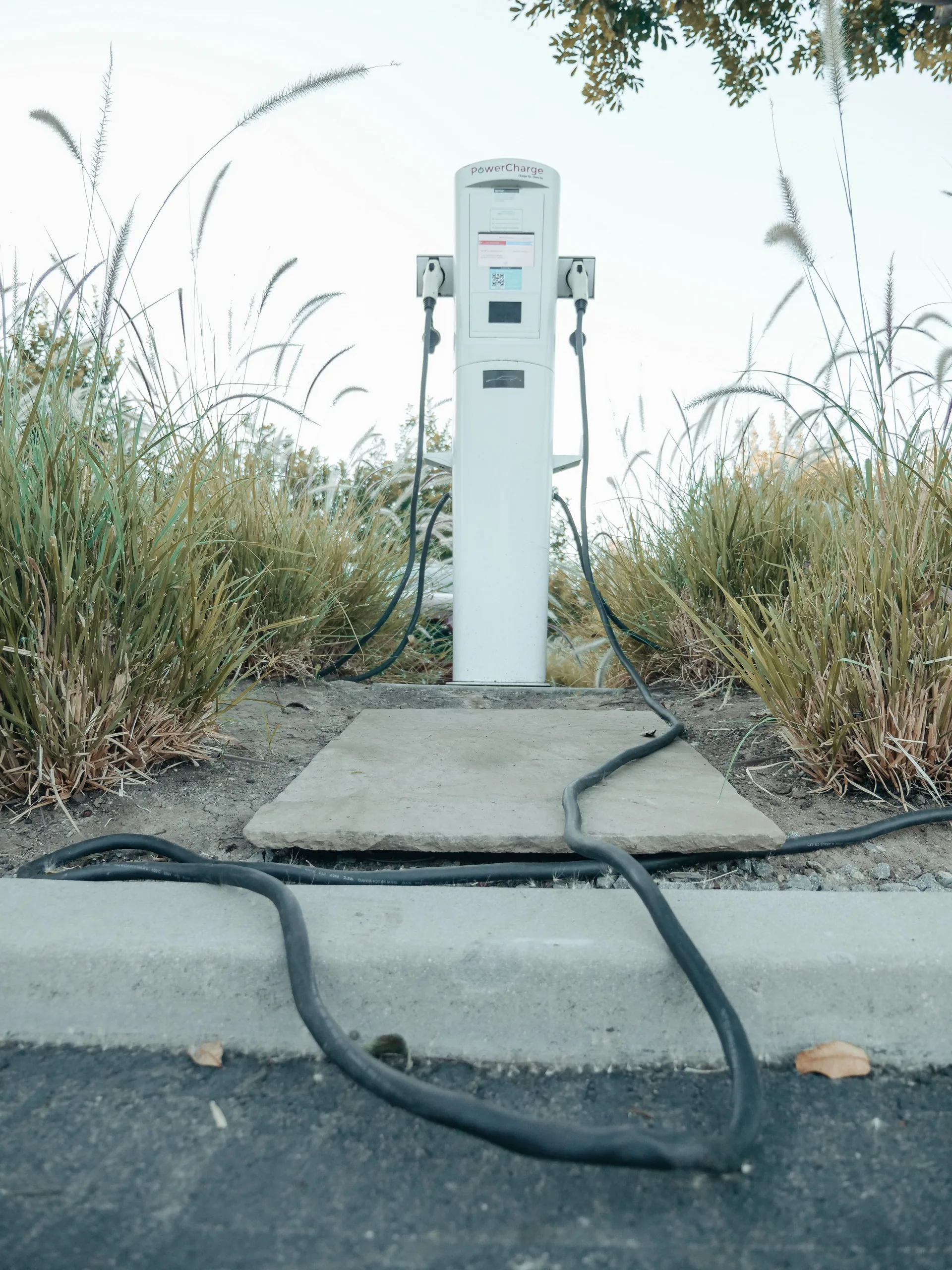
The panel and subpanel decision on a larger plot
A White City plot often holds more than a house: a garage, a workshop, an outbuilding, each with its own loads — and the panel decision has to cover all of them. A Level 2 charger needs its own dedicated 240V circuit that serves nothing else, and the breaker is sized at 125% of the charger’s maximum current because charging runs for hours: a charger that draws 40 amps needs a 50-amp breaker, and a 48-amp hardwired charger needs a 60-amp breaker. The double-pole breaker occupies two adjacent spaces in the panel, so the visit checks spare spaces as well as total capacity.
The load calculation is what confirms whether there is room — not the number stamped on the panel door. It totals the existing loads, applies the code’s demand factors, and adds the charger at its 125% value; a 200-amp panel might be oversized for the home’s actual use, and a 100-amp panel might have plenty of spare capacity. If the main panel is full or tight, the answers are a subpanel, a load-management device that slows the charger during heavy household use, or a panel upgrade — the calculation decides. Our EV charger panel capacity guide explains the load calculation and the three outcomes, our subpanel installation service covers the subpanel route, and our electrical panel upgrade Fort Pierce page covers capacity. The workshop subpanel is checked as part of the same system, because a strong workshop panel fed by a weak run still trips.
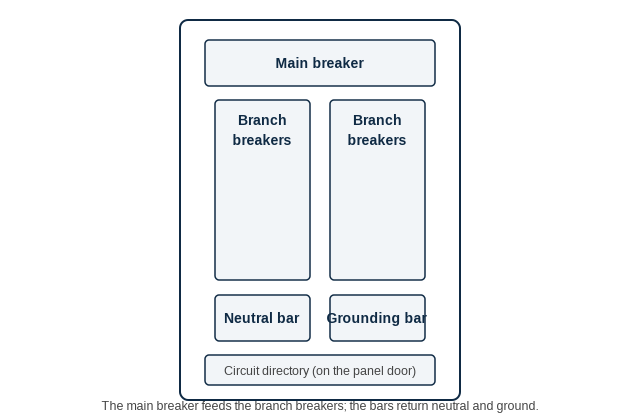
A panel with no spare spaces, a charger with nowhere to plug in?
Garage, driveway, or outbuilding: where the charger goes
On a larger western plot, the parking spot is a real decision, not an afterthought. A garage charger has the shortest cable run and the most protection from weather. A driveway charger needs an outdoor-rated unit, a pedestal or wall mount, and a cable route that does not cross a walkway. An outbuilding charger needs the run from the main panel to the outbuilding checked first — the distance, the trench or conduit, and the subpanel feeding it. The cable run sets much of the work, and on a larger plot the run is longer than it is on a city lot.
Outdoor-rated equipment matters on the Treasure Coast. Salt air corrodes outdoor fittings over time, and summer storms soak anything left exposed, so an outdoor charger needs a weatherproof enclosure built for the location and GFCI protection on the circuit. A charger mounted where water pools, or where a downspout dumps onto it, will fail early no matter how good the unit is. Our EV charger cost-factors guide explains what moves a quote — panel room, cable run, charger choice, and inspection steps — cost factors only, no dollar figures, because a long cable run and a workshop subpanel are different jobs from a short garage run.
The permit route for your address
Most cities require an electrical permit for a new charger circuit, followed by an inspection — and the route depends on the exact address. Whether a White City home falls under the City of Fort Pierce or St. Lucie County is checked by exact address, not assumed, and the permit and inspection steps follow from that jurisdiction. The visit confirms which one covers the address before work starts, so the inspection is booked with the right authority the first time.
The permit is also where the load calculation earns its keep: a written load calculation filed with the permit shows any future electrician or installer exactly what the panel carries and what the charger adds. EV charger installation White City Fort Pierce visits end with that paperwork in order — the permit, the inspection, and the calculation on file — because a charger without them is a liability at sale time, not just a missing stamp. Our EV charger permit guide explains what the code requires and how to check which jurisdiction covers an address.
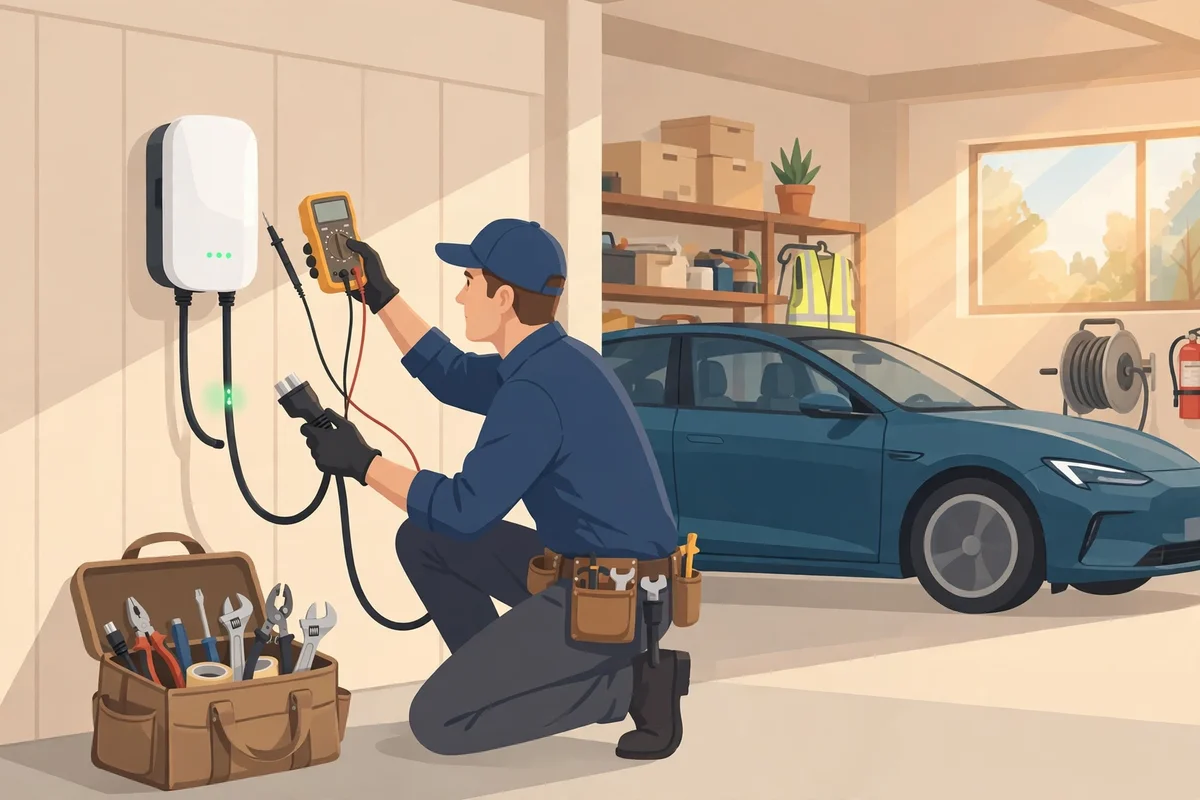
When the panel is tight: load management
A tight panel does not always mean a panel upgrade. A load-management device watches the home’s total draw and slows the charger when the air conditioner, water heater, and dryer run together, then restores full charging when the house quiets down. The car still charges overnight — it charges more slowly during the evening peak and faster after midnight. For a White City home where the panel is close to full but the overnight window is long, that trade is usually the right one.
Load management is also the answer when the workshop shares the service. A workshop subpanel feeding power tools can spike the total draw hard enough to trip the main, and a charger that ignores the workshop will trip with it. The management device treats the charger as the flexible load — the one that can wait — and the workshop, the air conditioner, and the house circuits as the loads that cannot. Our smart electrical panel installation service covers the monitoring that makes load management visible, and our generator installation in White City guide covers the same load set for backup power — the house, garage, and workshop sized together.
A charger that trips the main every evening, a workshop that shares the service?
What to have ready when you call
A charger visit in White City goes faster when six things are ready. Your address in ZIP 34950, and whether the home has a garage, a workshop, or an outbuilding — and whether it is yours or a rental, because a rental needs the landlord’s written permission first. Your panel’s brand and size, and whether there is a workshop subpanel. The charger model, or at least whether it is a Tesla Wall Connector or a universal charger. Where the car parks, and where a charger could mount. And the daily miles, because they decide whether Level 1 is enough or Level 2 is the answer.
Those answers turn a call into a visit that starts with the right check, instead of a visit that starts by searching for the problem. EV charger installation White City Fort Pierce homes get right is settled at the panel, with the load calculation done before anything is ordered. Call (772) 218-3629 any time; we are open 24/7, and same-day service is available. For the wider picture, our EV charger time estimator tool gives a first pass at charging times, and the White City area page covers the work we do in ZIP 34950.
EV Charger Installation in White City, Fort Pierce: frequently asked questions
What does a Level 2 charger need in a White City home?
Its own dedicated 240V circuit that serves nothing else, a load calculation confirming the panel has room, and a breaker sized at 125% of the charger’s maximum current — a 40-amp charger needs a 50-amp breaker, a 48-amp hardwired charger needs a 60-amp breaker. The double-pole breaker occupies two adjacent spaces in the panel.
Garage or driveway — which is better for a charger?
A garage charger has the shortest cable run and the most protection from weather. A driveway charger needs an outdoor-rated unit, a pedestal or wall mount, and a cable route that does not cross a walkway. On a larger western plot, the cable run sets much of the work, so the spot is decided by the run as well as the parking.
My panel is full — can I still get a charger?
It depends on the load calculation. A full panel may take a subpanel, a load-management device that slows the charger during heavy household use, or a panel upgrade — the calculation decides, and the visit checks the panel brand, spare spaces, and total load before anything is promised.
Does a charger need a permit in White City?
Most cities require an electrical permit for a new charger circuit, followed by an inspection. Whether the home falls under the City of Fort Pierce or St. Lucie County is checked by exact address, not assumed, and the permit route follows from that jurisdiction.
How much does the cable run matter?
A lot on a larger plot. The run from the panel to the parking spot sets much of the work: a short garage run is a different job from a long run to a driveway pedestal or an outbuilding subpanel. The run length is a cost factor, and the quote names it rather than hiding it.
What should I tell you when I call about a charger in White City?
Your address in ZIP 34950, your panel’s brand and size, the charger model, where the car parks, and whether there is a garage, workshop, or outbuilding. With those answers, the call ends with a clear scope and a written price. Call (772) 218-3629, 24/7.
Ready to talk?