
Automatic vs Manual Transfer Switch in Fort Pierce
When the power goes out, an automatic vs manual transfer switch Fort Pierce choice decides who does the work: the switch itself, or you, outside. This guide compares the two for homes from Hutchinson Island to Fort Pierce South in ZIPs 34950 and 34949, for your generator and household.
Call Now to Speak to a Specialist
Open 24 hours a day, 7 days a week.
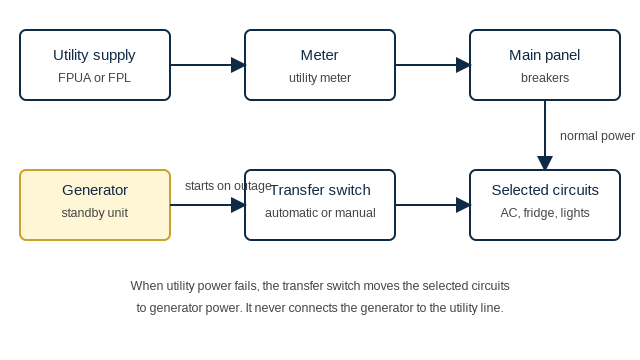
The short answer is that the generator decides the switch. A standby generator pairs with an automatic switch that moves the circuits itself, while a portable generator pairs with a manual switch that you operate by hand. Both keep generator power and utility power apart, which is the safety job either switch exists to do.
How an automatic transfer switch works
The automatic switch watches the utility feed around the clock. When voltage drops and stays down past a short delay, it signals the standby generator to start, waits until the output steadies, then moves the chosen circuits onto generator power. When utility power returns and holds steady, it moves the circuits back and lets the generator cool down before shutting it off. Nobody touches a panel, and nobody goes outside.
That unattended sequence is the whole point. It works at 3 a.m., in a downpour, and while the household is away — the three moments a manual sequence is hardest to run. The trade is compatibility: the switch must match the generator's output and control interface, because the two coordinate through electrical signals rather than a human hand. A mismatch is not a small detail; it is the difference between a system that starts itself and one that does not.
Want backup power that starts itself while you stay inside?
How a manual transfer switch works
The manual switch pairs with a portable generator and an exterior inlet box. When the power goes out, you walk out, start the engine, connect the cord to the inlet, and move the switch so the selected circuits run from the generator. When utility power returns, the sequence runs in reverse: switch back, disconnect, shut the engine down, and let it cool.
Manual equipment costs less to buy and fit, and it asks little of the panel beyond a matching rating — the switch and inlet only need to suit the generator's output. Its price is paid in participation instead: every outage means at least two trips outside, plus refuelling, in whatever weather the storm brought. If nobody is home, nothing happens until someone returns.
The interlock kit: a third option, not a switch
Between the two switches sits a third option worth knowing about, because it is often confused with a manual switch. An interlock kit is a lockout plate machined to one panel's breaker layout, holding the main breaker and a dedicated generator breaker so only one can close at a time. It is not a transfer switch at all — it is a mechanical guard on the panel you already own.
The interlock fits portable-generator households whose panel accepts the plate, and it is the lowest-scope route to a code-compliant connection. Which panels accept one, and what the plate changes about the breaker layout, is a panel question — our transfer switch versus interlock kit guide works through the comparison, the compatibility rules, and the cases where a switch fits better.
Four household questions that settle it
Four questions settle most choices, and the first is who is home during an outage. A household that evacuates for hurricanes, travels often, or includes someone who cannot operate equipment in the dark leans automatic, because a manual sequence nobody performs is an outage with extra steps. A household where someone is always home and able can run a manual sequence without trouble.
The second question is which generator you own or plan to buy: standby units pair with automatic switches, portable units with manual switches or interlocks. The third is which circuits matter — a whole-house backup, or only the essentials: fridge, lights, fans, and medical equipment. The fourth is how long outages usually run where you live, and how often the household wants to be outside tending a portable unit. That is the whole of an automatic vs manual transfer switch Fort Pierce choice: who does the work when the power goes out.
Not sure which switch your generator needs?
Response time, and what the house actually gets
An automatic switch moves the circuits in seconds to about a minute, counting the delay that confirms the outage is real and the time the generator needs to steady. A manual switch moves them as fast as the operator moves — minutes if you are home and ready, longer if you are asleep, away, or waiting out the worst of the storm.
Neither switch runs every circuit at once. The generator's output still sets the limit, and the backed-up circuits are chosen in advance so the load fits what the generator can carry. A switch sized wrong for the generator, or a circuit list that ignores the air conditioner's starting draw, will trip the generator's own protection no matter which switch you buy. Our sizing guide works through the load math, and our generator installation companies guide covers what to ask before hiring.
What each one costs — cost factors only
No dollar figure appears on this page: the exact price is given on the call. What shapes the scope is the equipment first — an automatic switch and its control wiring is a bigger fitting than a manual switch and inlet — then the generator it pairs with, the panel work it needs, and whether the job also moves circuits or adds a subpanel.
An automatic vs manual transfer switch Fort Pierce price question has no single answer, because the switch is only part of the job: the generator, the fuel route, the circuit list, and the permit and inspection steps all shape the scope. Tell us the generator and the panel on the call, and we will talk through the scope and the visit before any work is agreed.
The visit: matching the switch to your generator and panel
The visit works in order. First the generator: make, model, output, and whether it is standby or portable. Then the panel: brand, main breaker size, spare spaces, and condition. Then the circuit list: which rooms and loads must stay on, and which can wait. From those three the switch follows — automatic, manual, or interlock — and the fitting is planned around the panel in front of us, not a generic one.
Every automatic switch we fit is proved with a simulated outage before we leave, so the household sees the generator start, the circuits move, and the return sequence work. Our automatic transfer switch installation page sets out what the fitting itself covers, and our home generator guide covers the install sequence the switch sits inside. A visit for an automatic vs manual transfer switch Fort Pierce decision gives you the switch, the circuit list, and the exact price on the call. Call (772) 218-3629 whenever suits you — we are open 24/7, licensed and insured, with 23 years of experience and Master Electrician Certification.
Automatic vs Manual Transfer Switch in Fort Pierce: frequently asked questions
Do I need a transfer switch if I already own a generator?
Yes, for any connected use. A generator feeding house circuits through extension cords can only run what you plug in, and it cannot power the fridge, lights, and fans on their own circuits. A transfer switch or an interlock gives the generator a controlled route into the panel, keeps utility and generator power apart, and stops generator power flowing back onto lines that crews may be repairing.
Can a manual transfer switch run my whole house?
Only if the generator behind it can carry the chosen circuits. A manual switch moves whatever load you select onto the generator, so the circuit list still has to fit the generator's output. Most portable setups back up essential circuits — fridge, lights, fans, a few outlets — while the air conditioner and water heater wait for utility power. The visit sizes the list to the generator, not the other way round.
Will an automatic switch work with a portable generator?
No. An automatic switch pairs with a standby generator whose controls it can signal, because the start, stabilise, transfer, and shutdown sequence runs through the generator's own control interface. A portable generator has no such interface, so it pairs with a manual switch or an interlock kit, both of which you operate by hand. Matching the switch to the generator type is the first decision, not the last.
What happens if nobody is home when the power goes out?
With an automatic switch, the standby generator starts, the circuits move, and the house keeps running until utility power returns — nobody needs to be there. With a manual switch or an interlock, nothing changes until someone comes home, starts the portable unit, and moves the switch. That gap is why households that travel, evacuate, or have medical equipment usually choose automatic.
Does a transfer switch need a permit and inspection?
The permit route is confirmed on the call for your exact address, since the permitting office is decided by the property, not the neighbourhood. The fitting itself is inspected after installation, and an automatic switch is proved with a simulated outage before we leave. A portable generator must never feed house wiring without a proper transfer device, and it must never run indoors or in a garage.
What should I have ready when I call about a transfer switch in Fort Pierce?
Start with your generator — make, model, and output — and whether it is standby or portable. Add the panel brand and main breaker size, the circuits that must stay on, and who is usually home during an outage. With those answers we can say which switch fits, what the fitting involves, and the exact price. Call (772) 218-3629, 24/7.
Ready to talk?