
Circuit Breaker Replacement in Lincoln Park, Fort Pierce
Circuit breaker replacement Lincoln Park Fort Pierce starts with the diagnosis, not the part: for homes in ZIP 34945 and 34950, around Lincoln Park, Avenue D and Orange Avenue, a breaker that will not reset, runs hot, or buzzes can mean a worn breaker, a loose connection, or a panel.
Call Now to Speak to a Specialist
Open 24 hours a day, 7 days a week.
A circuit breaker in Lincoln Park needs replacing when the breaker itself has failed: it will not stay reset, it trips on a quiet circuit, it runs hot, it buzzes, or it shows scorch marks. A single trip after an overload is different — that breaker did its job. Below, the visit's test tells the two apart.
The Lincoln Park pattern: older homes, older breakers
Lincoln Park is one of Fort Pierce's oldest neighbourhoods, and its breakers have usually been working longer than the ones in a newer subdivision. Homes around Avenue D and Orange Avenue, near Lincoln Park Academy, were wired to the standards of their time. That age makes circuit breaker replacement Lincoln Park Fort Pierce a diagnosis job first: a tripping breaker in a historic home can be a worn mechanism, a connection loosened over years of thermal expansion and contraction, or a panel that has run out of life.
The Lincoln Park area page sets the order for work here — inspection first, panel decision second — and a breaker job follows the same order. Our electrical repair guide for Lincoln Park covers the fault pattern across these older homes. The rest of this guide stays with the breaker itself: what each failure looks like, how the visit tells a bad breaker from a bad circuit, and when the honest fix is panel work.
A breaker that will not reset
A circuit breaker won't reset Lincoln Park Fort Pierce callers describe most often trips straight back the moment it is pushed on, or will not stay on at all. First, unplug everything on that circuit, then try one reset. If it holds with nothing plugged in, the load was the problem. If it trips again with nothing running, the fault is in the breaker, the bus, or the wiring — and the breaker may be doing its job by refusing to stay on.
That refusal is a warning, not a defect to work around. A breaker that will not latch may be sitting on a fault it is fitted to stop, so never hold it, tape it, or force it on — every reset after a fault wears the mechanism and hides the cause. Leave the circuit off and call us. A burning smell or scorching around the breaker means treat it as an emergency and keep clear of the panel until we arrive.
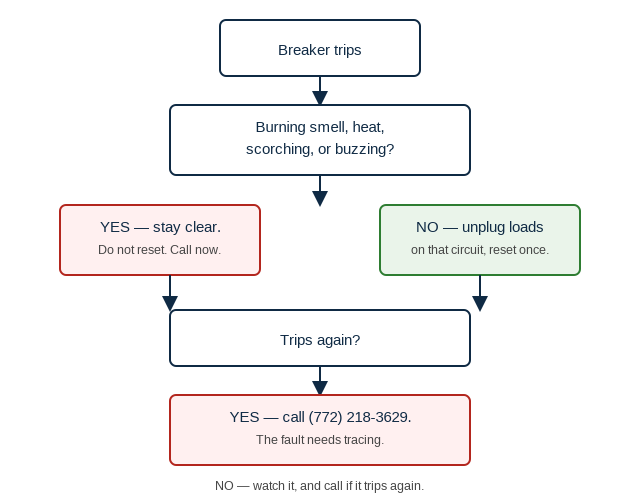
A breaker that will not stay on, or one that trips the moment you reset it?
A trip on a quiet circuit
A trip on a quiet circuit is the most useful clue a Lincoln Park breaker gives. When a breaker trips with nothing running — no air conditioner, no laundry, no kitchen load — the cause is not an overload, because there is nothing to overload it. The fault is either in the breaker's own mechanism, which no longer latches or trips below its rated amperage, or in the wiring, where a loose connection or damaged insulation leaks current. Telling the two apart takes testing: the visit measures the circuit under load and checks the breaker off the bus, so the part that failed is the part that gets replaced.
A breaker that trips once on a quiet circuit and then holds for weeks may be a mechanism on its way out; one that trips every time it is reset on the same quiet circuit is pointing at a fault that is still there. Either way, leave it off, note what was running when it tripped, and call. Our breaker tripping guide explains what overload, short circuit, ground fault, and a worn breaker each look like.
Hot, buzzing, or scorched: the call-now signs
A hot breaker Lincoln Park homeowners sometimes describe as a warm handle or a warm panel door is a call-now sign, not a monitor-it one: heat means resistance is generating warmth where it should not be, usually at the breaker's contacts, at the terminal where the wire lands, or at the bus clip where the breaker grips the bus bar. A steady buzz or crackle from one breaker is arcing at that same point — a buzzing breaker Fort Pierce callers should never ignore.
Scorch marks tell the same story. Look, without opening the panel, for darkening on the breaker body, on the plastic around its slot, or on the wire insulation at its terminal: scorch marks breaker Fort Pierce visits find are usually paired with heat or a smell, and any one of the three means the circuit stays off and the call is urgent. A burning smell with no visible mark counts the same. Keep clear of a hot, buzzing, or marked panel, and if you see sparks or smoke, call 911 first.
A hot handle, a buzz, or scorch marks at the panel?
The handle test: a wobble with no click
A breaker's handle is a small thing that tells a lot. A healthy breaker snaps firmly between on and off, with a clear click at each end. A handle that wobbles, moves without a click, or feels spongy has a worn mechanism inside. That breaker may still pass current today, but it can no longer be trusted to trip when it must.
Do the handle test safely from outside the panel: move the handle gently and feel for the click — do not force it, and do not open the panel. If it wobbles, note which breaker it is and call. The visit fits the listed replacement for that panel and checks the bus and connections first.
Breaker or panel? The test that decides
In a Lincoln Park home, a single failed breaker is usually a single job: the visit fits the listed replacement, tests it, and leaves. The job grows into a panel decision when the trouble is spread across the box: several breakers warm at once, buzzing that cannot be traced to a single slot, or a main breaker that runs hot while the branch breakers stay cool. Those signs point past the breaker to the panel itself — an overheated bus bar, connections loosened over years of heat, or a panel that is full, obsolete, or damaged.
The bus bar is where a breaker swap can fail. A loosened clip arcing against the bus burns the bus finger as well as the breaker, and a new breaker fitted onto a pitted finger fails again. That is why the visit checks the bus before anything is swapped, and why circuit breaker replacement Lincoln Park Fort Pierce sometimes ends as a panel decision instead. A Federal Pacific Stab-Lok or Zinsco panel, or a fuse box instead of breakers, is the same story: those are replace-first brands, and our Federal Pacific versus Zinsco guide explains how to identify them.
The breaker vs panel upgrade Fort Pierce decision is made by the load calculation, not by the count of breakers that tripped. When the service is sound and only short of spaces, a subpanel gives the room the job needs; when the panel itself is the problem, the honest call is panel work. Our panel upgrade page covers the capacity question, and our Federal Pacific panel replacement Fort Pierce and Zinsco replacement pages cover the work.
When the circuit is overloaded, not the breaker
Not every tripping breaker is a bad breaker. An overloaded circuit has its own pattern: it trips only when several high-draw appliances run together, in the same combination — the air conditioner, the microwave, and a space heater — while other breakers behave normally. When a breaker keeps tripping Lincoln Park homeowners usually notice the pattern first: the same appliances, the same time, the same breaker. That consistency is the clue — the breaker is doing its job; the circuit is simply carrying more than it was sized for.
The fix for an overloaded circuit is a dedicated circuit, not a fresh breaker — and never a bigger breaker. Fitting a higher-rated breaker onto wiring rated for less lets the wiring overheat with no safety shutoff, the very failure the breaker exists to prevent. The most worrying sign is the opposite one: a breaker that fails to trip when the circuit is clearly overloaded. A breaker that cannot protect the wiring cannot be left in place, whatever else looks fine.
A circuit that trips every time the same appliances run together?
What the replacement visit does
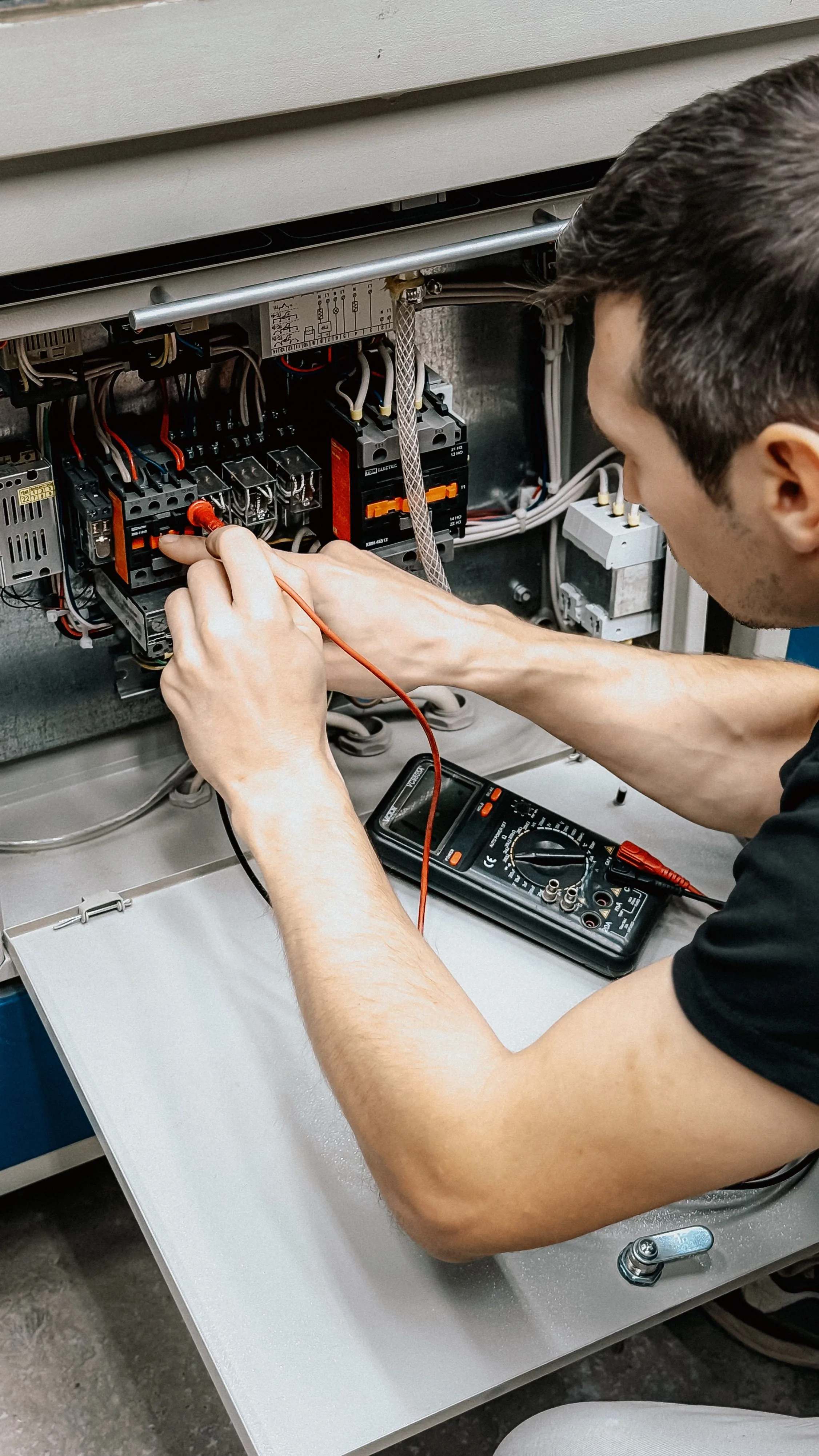
A breaker replacement Lincoln Park Fort Pierce visit runs in a fixed order. Power off first, then the old breaker comes out and the bus stab it sat on is inspected — a pitted or burnt stab would fail a new breaker on it, so it is dealt with before the new part goes in. Only the breaker listed for that panel is fitted, because a look-alike from another brand is a shortcut an inspector will flag. Terminal connections are checked at the same time, and the visit checks whether the circuit now needs arc-fault or ground-fault protection it was fitted without — AFCI for living areas, GFCI for wet and damp ones.
The visit then proves the circuit instead of assuming it: power back on, the circuit tested under load, and the breaker that holds is the breaker that stays. The panel gets labelled before the visit ends. And not every trip ends with a swap — a breaker that trips once after a clear overload, then resets and holds, has done its job, so the visit leaves it alone and chases the cause of that one trip.
Cost factors and what to tell us when you call
What the visit costs depends on the breaker and what sits behind it: the listed part for that panel, the state of the bus bar, the panel brand, and whether a dedicated circuit or panel work follows the swap. Access matters in an older Lincoln Park home too — a panel in a tight closet or behind stored boxes takes longer to reach than one on an open wall. The visit turns those factors into a written price for your address; the exact price is held for the call.
Circuit breaker replacement Lincoln Park Fort Pierce comes down to the panel and the bus, and the visit begins with the diagnosis, not the part. Call (772) 218-3629 whenever the trouble shows up — the lines are open around the clock, with same-day service available. We are licensed and insured, with 23 years of experience and Master Electrician Certification. If you need an electrician Lincoln Park Fort Pierce residents can call at any hour, start at the Fort Pierce Electric Pros homepage — or call now about the breaker giving trouble.
Circuit Breaker Replacement in Lincoln Park, Fort Pierce: frequently asked questions
My breaker will not reset in Lincoln Park — what do I do?
Try one reset, with everything on that circuit unplugged. If it trips straight back, or will not stay on, leave it off and call us — the fault is in the breaker, the bus, or the wiring, and every reset after a fault wears the breaker and hides the cause. A burning smell or scorching around the breaker means treat it as an emergency, leave the circuit off, and call.
How does the visit tell a worn breaker from a wiring fault?
By testing, not by guessing. The visit checks the trip pattern first — when it trips, what was running, and whether it holds with nothing plugged in — then measures the circuit under load and tests the breaker off the bus. A breaker that trips below its rated amperage, or will not latch, is faulty. A circuit that tests wrong with a sound breaker has a wiring fault, and the visit finds it first.
A breaker that trips with nothing running — is it the breaker or the circuit?
It can be either — only testing tells them apart. A trip on a quiet circuit means the fault is in the breaker's own mechanism or in the wiring on that circuit, not in the load — because there is no load. The visit tests the breaker off the bus and measures the circuit, so only the failed part gets replaced. Never hold, tape, or force a breaker that will not stay on.
What does a hot or buzzing breaker mean in an older Lincoln Park home?
Heat means resistance is making warmth where it should not be — at the breaker's contacts, at the wire terminal, or at the bus clip. A steady buzz or crackle is arcing at that same point. In older homes, connections loosen over years of thermal expansion and contraction, so a breaker that ran fine for years can start heating without anything changing on the circuit. Both signs mean call now, not monitor it.
Does a Federal Pacific or Zinsco panel change the fix in Lincoln Park?
Yes, it changes the fix before the visit. A breaker in a Federal Pacific Stab-Lok or Zinsco panel, or on a pitted bus bar, is not a one-breaker job — fitting another breaker onto failing equipment only moves the failure along. A loosened clip arcing against the bus burns the bus finger as well as the breaker, so a new breaker there fails again. The honest call is panel replacement, confirmed by the brand check first.
What should I tell you when I call about a breaker in Lincoln Park?
Your street and ZIP 34945 or 34950, your panel's brand and size, which breaker trips and what runs on it, and whether it feels loose, warm, or smells of burning. Tell us whether it trips with nothing running, or only when the same appliances run together — that pattern decides what the visit tests. With those answers, the call ends with a clear scope and written price. Call (772) 218-3629, 24/7.
Ready to talk?