
Ceiling Fan Installation in Fort Pierce
Ceiling fan installation Fort Pierce — a fan is heavier than a light, moves while it runs, and hangs over the room, so the box, the brace and the mount decide whether it stays safe: the guide for Lakewood Park and Fort Pierce North homes, ZIPs 34950 and 34946.
Call Now to Speak to a Specialist
Open 24 hours a day, 7 days a week.
Ceiling fan installation in Fort Pierce: the short answer
Ceiling fan installation Fort Pierce is a mounting job before it is a wiring job: the fan must hang from a box rated for a moving load, on a brace that holds it still, at a height that clears heads and moves air. This guide covers the box, the mount, the controls and the wobble check, in visit order.
The box decides everything: fan-rated or not
A ceiling fan is a moving load, and that is what makes the box the whole job. A light fitting hangs still; a fan spins, pulls and vibrates, and over months that movement works on anything that is not made to hold it. A box rated for a fan is secured to a joist or held by a brace between joists, and it carries the fan's weight plus the movement. A box made for a light does not, however solid it looks from below. Our ceiling-fan-rated-box guide owns the box-rating ground — this post links to it rather than repeating it.
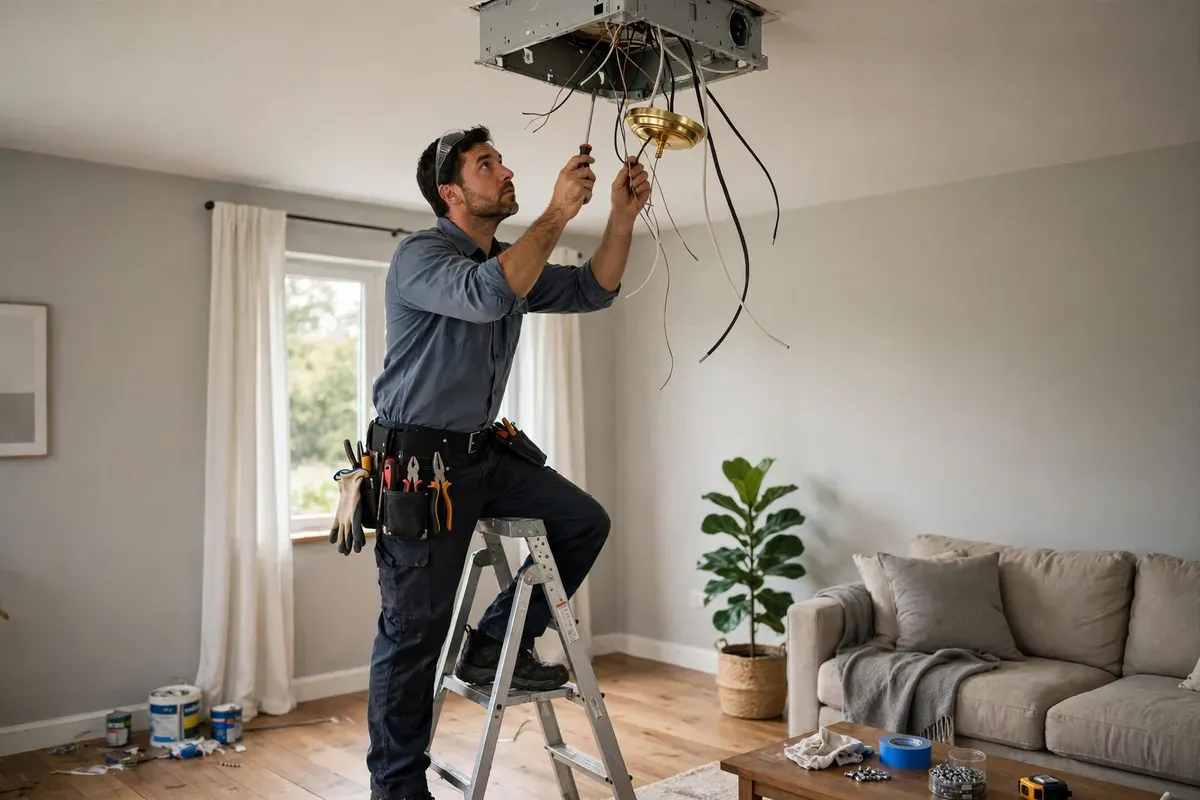
The first check on any visit is therefore the box, not the fan. A box that flexes when pushed, a canopy that hides a loose fitting, or a box screwed only to plasterboard must be replaced before a fan is hung. A decorative canopy does not correct an unsuitable or loose box, and a fan hung from one will tell you about it sooner or later, usually as a wobble that grows. The ceiling fan installation page sets out the fitting scope the visit agrees.
Brace or bar: how the fan is held up
Where the ceiling is open from above, the fan box is fixed directly to a joist, and that is the simplest mount there is. Where the ceiling is finished and the fan goes where a light was, the box is usually held by a brace — a bar that spans between two joists and carries the box in the middle. The brace is fitted through the existing ceiling opening where the opening allows it, and the box is then fixed to the brace, not to the plasterboard around it.
Opening a finished ceiling to fit a brace is a bigger job than a swap, and it is permit work when the box moves or a new ceiling point is added. The visit checks the joist spacing, the attic access and the ceiling construction before the fan is chosen, because the mount that fits a flat eight-foot ceiling is not the mount that fits a vaulted one. If the brace cannot be fitted through the opening, the ceiling is opened in a planned way and made good after — the cost of the opening is part of the quote, not a surprise on the day.

Fan wobbling, humming, or hanging from a box you are not sure about?
Downrod or flush mount: height decides
Height decides the mount, and the mount is chosen before the fan. Most fan makers call for the blades to clear the floor by at least 7 feet, and that one figure sorts most rooms: a low ceiling takes a flush mount, sometimes called a hugger, which keeps the blades as close to the ceiling as the fan allows. A standard eight- or nine-foot ceiling takes a short downrod, which drops the fan into the air it needs to move without bringing the blades near head height.
A high or vaulted ceiling takes a longer downrod, and a sloped ceiling takes an angled adapter or a mount made for a slope — a fan hung level on a slope needs the adapter, not a workaround. The wrong mount shows itself fast: a fan too close to the ceiling moves little air and runs loud, and a fan hung too low is a hazard in a room people walk through. The visit measures the ceiling and the slope before the fan is chosen, and the downrod length follows the measurement.
Controls: pull chain, wall control or remote
A ceiling fan has three ways of being controlled, and they are not interchangeable. The pull chain is the fan's own control: it is simple, it always works, and it needs no wiring change. A wall control replaces the switch and gives speed control from the door, but it must be a fan-rated control — a light dimmer must never drive a fan motor, because it can make the motor hum, run hot or fail early. Our dimmer-switch-installation guide owns the dimmer ground, and the LED-flicker-on-a-dimmer guide explains the mismatch from the lighting side.
A remote puts a receiver in the fan canopy and a handset on the wall or the bedside, and it suits a fan over a bed or a high ceiling where the chain is out of reach. A smart control adds the fan to a home system, and it is wired like a wall control with the fan's own receiver doing the speed work. Two switches — one for the fan, one for the light kit — suit a room where the light and the fan are used separately. The control is confirmed before any wiring is done, because the wiring behind the switch depends on which control is chosen.
Wobble and hum: what they mean and what fixes them
A fan that wobbles is telling you something, and ceiling fan installation Fort Pierce treats the wobble as a symptom to read, not a quirk to live with. The usual causes sit in a short list: a mount that was never tight, a blade set that is not balanced, a bent blade bracket, or a downrod that is not seated in its socket. A balance kit — small weights clipped to the blades — helps when the blades themselves are uneven, but it cannot fix a loose box or a mount that moves, and a wobble that starts suddenly deserves a check rather than a weight.
A hum has its own short list. Loose canopy screws and loose blade screws are the common mechanical causes, and they are checked first. A control mismatch is the electrical cause: a light dimmer driving the motor will hum, and it will shorten the motor's life. A fan that hums only on one speed, or one that has hummed since the day it was fitted, is usually a control problem rather than a fan problem. The visit works through the mount first and the control second, because a fan that is solid and still hums is telling you about its wiring, not its blades.
The Fort Pierce details: lanai fans, salt air and damp ratings
A fan on a lanai is not an indoor fan moved outside. A lanai or a damp bath needs a damp- or wet-rated body, not an indoor fan with an open canopy, because salt air punishes indoor fittings: the same corrosion that attacks outdoor panels and pool equipment works on a fan's motor housing, blades and fixings. A wet-rated fan suits a spot that rain can reach; a damp-rated fan suits a covered lanai or a bath where steam is the exposure. Our outdoor-kitchen-and-patio guide covers wet-location devices from the same angle.
Lakewood Park and Fort Pierce North homes ask for lanai fans often, and the visit checks the rating before the fan is chosen, not after it is hung. An outdoor fan also needs its circuit checked: a lanai fan on a circuit that is not protected the way an outdoor circuit should be is a job for the visit, not a detail to leave. The track-lighting guide covers the other ceiling-work option for rooms where a fan is not the answer, and the chandelier-and-under-cabinet guide covers the lighting side of the same ceilings.
Planning a fan for a lanai, a vaulted ceiling, or a room with no fan box yet?
Cost factors only, and what to have ready for the call
Exact price and timing are confirmed on the call, and a ceiling fan quote moves on a short list of factors: the fan's size and weight, whether the box and brace are already fit for a fan or need replacing, the ceiling height and access, the control work, and any permit step when the box moves or a new ceiling point is added. A like-for-like swap on a sound fan-rated box is a different job from a first-time fan in a room that has never had one, and the quote says which one it is.
Ceiling fan installation Fort Pierce is settled by the box, the height and the control — not by the fan in the box. Call (772) 218-3629 any time; we are open 24/7, licensed and insured, with 23 years of experience and Master Electrician Certification. The lighting installation page covers the lighting side of the same ceilings, and the lighting repair guide covers a fitting that has stopped working. More of our work is listed on the Fort Pierce Electric Pros homepage.
Ceiling Fan Installation in Fort Pierce: frequently asked questions
Can any ceiling box hold a ceiling fan?
No. Only a box rated for a fan, secured to a joist or held by a brace between joists, is fit to carry one. A box made for a light fitting is not rated for a moving load, and a fan hung from one can work loose over time. The visit checks the box before the fan is hung, and a box that flexes when pushed is replaced first. The box-rating ground is in our ceiling-fan-rated-box guide.
Why does my ceiling fan wobble?
A wobble usually comes from a loose mount, an unbalanced blade set, a bent blade bracket, or a downrod that is not seated in its socket. A balance kit helps when the blades themselves are uneven, but it cannot fix a loose box or a mount that moves. A fan that starts wobbling suddenly, or one that has always wobbled, needs a check rather than a workaround, because the cause may be the mounting, not the blades.
Can a ceiling fan go where a light fitting was?
Often yes, when the box is already fan-rated or can be replaced with one. The visit confirms the box, the brace and the wiring before the fan is hung. When the ceiling has to be opened for a brace, or the box has to move to a new ceiling point, that is permit work, and the permit and inspection route is confirmed on the call. A like-for-like swap on a sound fan-rated box is a service-level visit.
What is the right height for a ceiling fan?
Most fan makers call for the blades to clear the floor by at least 7 feet. A low ceiling takes a flush mount, sometimes called a hugger, which keeps the blades as close to the ceiling as the fan allows. A high or vaulted ceiling takes a downrod, and a sloped ceiling takes an angled adapter or a mount made for a slope. The height is settled before the fan is chosen, because it decides the mount.
Can I control a ceiling fan with a dimmer switch?
No. A light dimmer must never drive a fan motor: it can make the motor hum, run hot, or fail early, and it does not give smooth speed control. A fan needs a fan-rated wall control, its own pull chain, or the remote that comes with it. If a room has only a dimmer on the wall, the control is changed as part of the install, and the dimmer-compatibility question is settled before any wiring is done.
What should I have ready when I call about a ceiling fan?
The ceiling height and whether it slopes, what is on the ceiling now, whether the room has a pull chain, wall control or remote in mind, and how the room is used. With those facts the call can say whether the box, the mount and the controls are straightforward or need a visit first. Call (772) 218-3629, 24/7.
Ready to talk?