
Overload vs Short Circuit vs Ground Fault in Fort Pierce
Overload vs short circuit vs ground fault Fort Pierce — three faults, three different dangers, and three different fixes: what each one is, how fast it trips the breaker, and which protection catches it in a Fort Pierce home in ZIP 34950.
Call Now to Speak to a Specialist
Open 24 hours a day, 7 days a week.
Overload vs short circuit vs ground fault Fort Pierce is the question behind a tripped breaker: the trip itself tells you almost nothing, and the fix depends on which fault caused it. An overload is too much load on one circuit; a short is current taking a shortcut; a ground fault is current leaking where it should not go.
Three faults, one tripped breaker — why the name matters
A breaker trips for all three faults, and that is exactly why the name matters: the trip is the same click, but the fault behind it decides the fix. An overload is fixed by moving loads or adding a circuit, a short circuit by finding damaged wiring, a ground fault by finding where current is leaking. Guess the wrong one and the breaker trips again — or worse, the fault stays in the wall.
Homeowners mix the three terms up constantly, and so do plenty of online guides — all three end with a dark room and a breaker that will not stay on. But the three faults take different paths, trip at different speeds, and carry different dangers: fire for two of them, shock for the third. Our breaker-keeps-tripping guide starts from the symptom; this post owns the comparison. The table below is the whole comparison in one place.
The three faults side by side
| Fault | What happens | Where the current goes | How fast the breaker trips | Main danger | What catches it |
|---|---|---|---|---|---|
| Overload | Too much load on one circuit | Through the circuit, more than it is rated for | Seconds to minutes | Overheated wires, fire | Thermal part of the breaker |
| Short circuit | Hot wire touches neutral or ground | A shortcut with almost no resistance | Instantly | Fire, arcing, panel damage | Magnetic part of the breaker |
| Ground fault | Current leaks to ground | Through water, a person, or equipment casing | A fraction of a second, on a GFCI | Shock | GFCI |
Overload: too much load on one circuit
An overload is the simplest of the three: the circuit is asked to carry more current than it is rated for. Nothing is broken and nothing is leaking — the wiring is sound, the devices are sound, and there is simply too much of them on one breaker. A Fort Pierce evening is the classic case: the air conditioner starts while the pool pump is already running, and a space heater, hair dryer or microwave joins them. Each load alone is ordinary; together they pass the rating.
The trip is slow, and that slowness is the clue: the thermal part of the breaker heats up as the excess current flows and lets go after seconds or minutes — sometimes long enough for the lights to dim first. If the breaker trips a few minutes after the air conditioner starts, or every time the same two appliances run together, the fault is almost certainly an overload. The fix is a load fix: move a load to another circuit, put the heavy appliance on a circuit of its own, or settle the panel capacity question. Our dedicated-circuits guide sets out which appliances need a circuit of their own; the flicker side is in our lights-flicker-when-the-AC-starts guide.
Short circuit: current takes a shortcut
A short circuit is current skipping the load and taking a shortcut between the hot wire and the neutral or ground wire. With almost no resistance in the way, the current spikes to many times the circuit rating in an instant, and the magnetic part of the breaker reacts in a fraction of a second — often with a bang, a flash, or a scorch mark at the fault. The causes are physical: insulation worn where a cable rubs, a nail through a cable, a wire shaken loose in a box, or water bridging the conductors.
A short circuit is a fire fault: the heat at the shortcut can ignite insulation, and the arcing can damage the panel. The fault is in the wiring, not in the loads, so nothing you unplug will fix it — the breaker trips again the moment it is reset, because the shortcut is still there. Do not keep resetting a breaker that trips instantly, and do not hold it on: every reset feeds the fault again. If there is a burning smell, scorch marks, or smoke, keep clear and call — sparks or smoke mean 911 first. Our electrical safety guide sets out the first steps for a fault that smells hot.
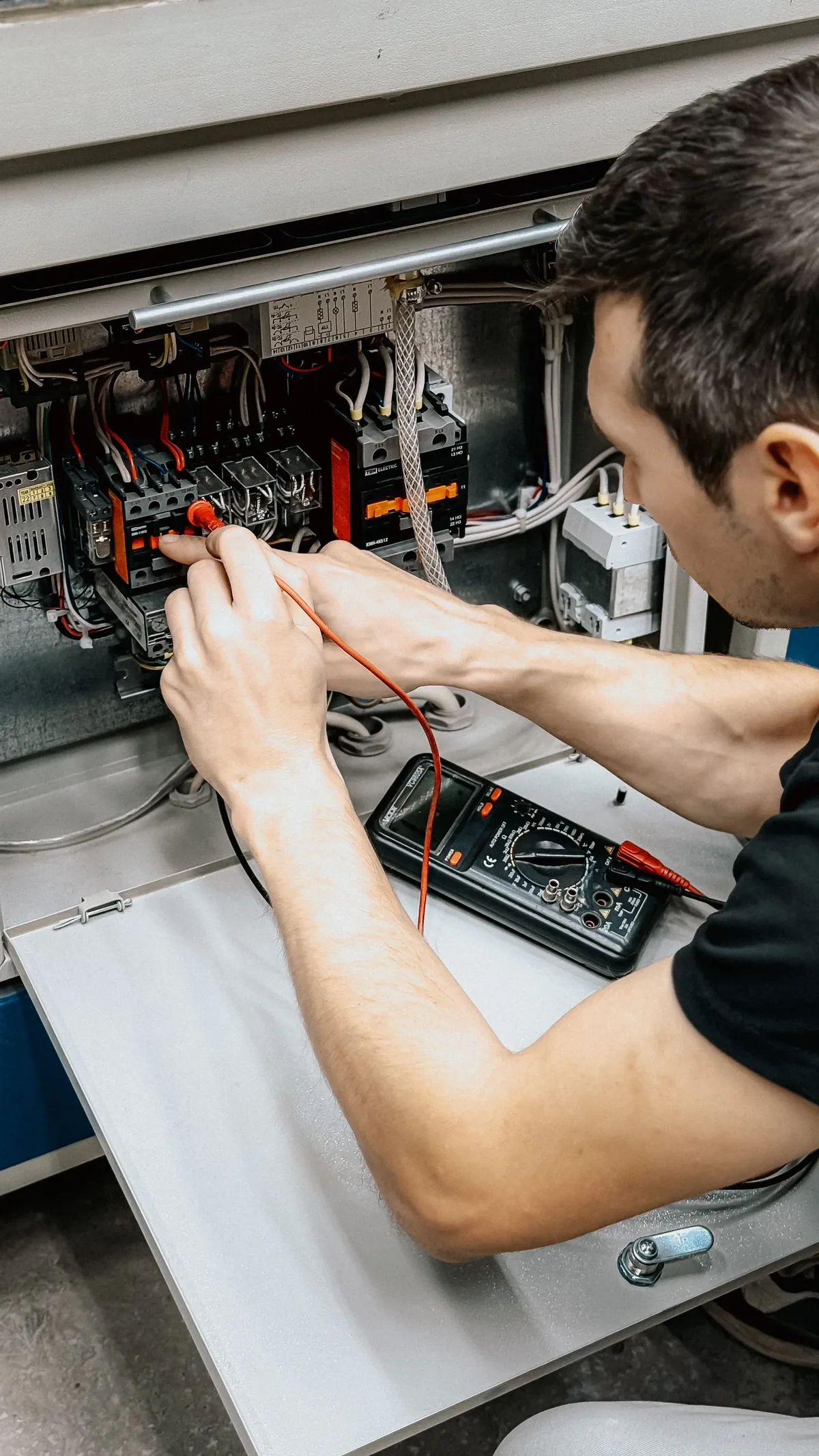
A breaker that trips the instant you reset it, or a scorch mark near an outlet?
Ground fault: current leaks where it should not go
A ground fault is current leaking out of its proper path and finding its way to ground through something it should never pass through: water, damp earth, a metal appliance casing, or a person. The circuit may still work — the lights may even stay on — because the current is not shorting the wires together; it is escaping, a little at a time, and that is what makes it dangerous to touch.
The Fort Pierce version of this fault is moisture: salt air corrodes connections on the barrier island and the coast, outdoor receptacles and pool equipment live in humidity, and a roof leak or a flooded garage can put water where the wiring runs. A GFCI outlet that trips on a damp morning, a pool pump circuit that will not hold after rain, or a tingle from a metal casing are all ground-fault shapes. Our salt-air corrosion guide covers the corrosion side, and our pool bonding and GFCI guide covers the pool side. The protection is the GFCI: it watches the current going out against the current coming back, and trips when a tiny amount goes missing — far below what a breaker would ever notice.
How to tell them apart when a breaker trips
Start with timing, the most honest witness. A trip the instant you reset the breaker, with a bang or a flash, points to a short circuit. A trip minutes after a big appliance starts, or when the same two appliances run together, points to an overload. A GFCI that will not reset — while the breaker itself holds — points to a ground fault on that circuit.
Then ask what was running, and what you can see. The three-way question — overload vs short circuit vs ground fault Fort Pierce — is answered by timing first: an instant trip with a flash or a bang points to a short, a trip minutes after the air conditioner starts points to an overload, and a GFCI that will not reset points to a ground fault. A burning smell or scorch marks mean a short or an overload that has already heated something; a tingle from a casing means a ground fault that needs the circuit off now. Two more checks narrow it further: if the trip follows one appliance, the appliance is the fault; if it follows one circuit, the circuit is the fault. Our outlet-not-working guide walks through the GFCI reset check step by step.
Which protection catches each fault
A standard breaker carries two protections in one device, and each half answers a different fault. The thermal half is a strip that bends as it heats: it answers an overload, slowly, because an overload heats the wire slowly. The magnetic half is a coil that snaps the breaker open on a sudden current spike: it answers a short circuit, instantly. One breaker, two faults, two speeds.
The GFCI answers the third fault, and it answers nothing else. It does not protect against overloads — a GFCI will happily pass an overloaded circuit until the breaker trips — and it does not replace a breaker for a short circuit. It watches for leakage, and leakage alone. The AFCI answers a fourth shape, arcing — a damaged wire sparking inside a wall — which is the fault behind many fires no breaker and no GFCI catches on its own. Our GFCI versus AFCI guide lays out where each device belongs; the panel upgrade page covers what a panel change adds in protection.

Not sure which fault tripped your breaker?
What never to do after a trip
Four things are never the answer, whatever the fault. Never fit a bigger breaker to stop the tripping — the breaker size protects the wire, and a bigger breaker lets the wire carry current it was never sized for. Never hold a breaker on or tape it in place — a breaker that will not hold is telling you something, and forcing it feeds the fault. Never bypass a GFCI that will not reset — it is tripping because current is leaking, and bypassing it removes the only protection against shock. And never open the panel — the bus bars behind the cover stay live even with the main breaker off.
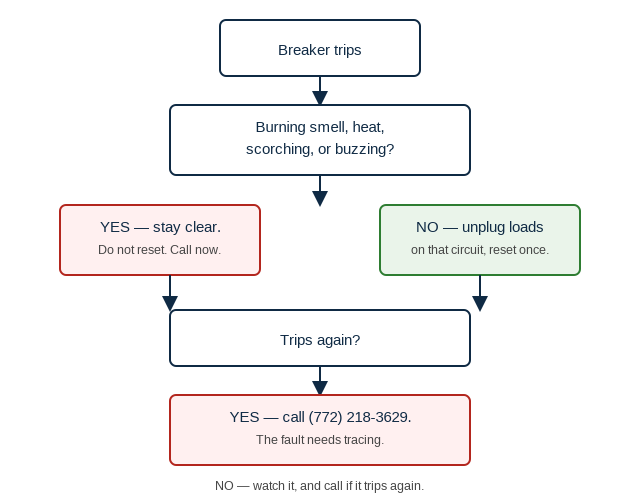
Match the move to the fault. For a suspected overload, unplug the heavy loads, reset once, and run one at a time to find the combination that trips it. For a suspected short, do not reset again: leave the breaker off and call. For a suspected ground fault, press the GFCI reset once; if it will not stay in, leave the circuit off and call. A burning smell, scorch marks, or a warm or buzzing panel means a call now — do not touch anything that looks or smells hot. One trip is a question; repeated trips are an answer, and a breaker that trips every evening is telling you about a circuit that needs work. Our panel repair guide covers what a repair visit settles.

What the visit checks, and what to have ready for the call
The visit starts with the timing you describe, then tests the circuit — the loads on it, the breaker itself, the devices on it, and the wiring between them. An overload shows up in the load list, a short in the wiring, a ground fault in the leakage test. The test settles which fault it is, and the fault settles the fix: a dedicated circuit, a rewired run, or a GFCI and the leak it catches.
A call goes faster with four things ready: which breaker tripped, and whether it was the breaker or a GFCI; how fast it tripped and what was running; whether there is a smell, a scorch mark, warmth or a buzz near the panel or an outlet; and whether the trip follows one appliance or one circuit. Our warm outlet guide covers the warmth check, and our licensed electrician guide covers the hiring checks.
Three faults, one tripped breaker, and a different fix for each — that is the whole post in one line. The same three faults show up in every Fort Pierce home, with a salt-air and moisture edge that makes ground faults more common here than inland. Overload vs short circuit vs ground fault Fort Pierce is settled by the timing, the load list, and the test — not by guessing at the breaker. Call (772) 218-3629 any time; we are open 24/7, licensed and insured, with 23 years of experience and Master Electrician Certification. The rest of what we do is on the Fort Pierce Electric Pros homepage.
Overload vs Short Circuit vs Ground Fault in Fort Pierce: frequently asked questions
How do I tell an overload from a short circuit?
By timing. An overload trips seconds or minutes after a big appliance starts, or when two heavy loads run together. A short circuit trips instantly, often with a bang or a flash, and trips again the moment you reset it. If the breaker holds for a while, think overload; if it trips at once, think short.
Why does my breaker trip minutes after the air conditioner starts?
Because the air conditioner is the heaviest load on the circuit, and its start-up draw tips an already-loaded circuit over its rating. The thermal part of the breaker heats up over a minute or two, then lets go. If the same circuit also carries a pool pump or a microwave, the combination is the cause.
What does it mean when the GFCI trips but the breaker does not?
It means current is leaking to ground on that circuit — a ground fault — while the total load stays inside the breaker rating. The GFCI watches for leakage the breaker cannot see. Press the reset once; if it will not stay in, leave the circuit off and call. Moisture and salt-air corrosion are the common Fort Pierce causes.
Can a short circuit cause a fire even if the breaker trips?
Yes. The breaker trips in a fraction of a second, but the current spike before the trip is enormous, and the heat at the shortcut can ignite insulation before the breaker opens. Arcing at a damaged wire can keep smouldering after the trip, too. A breaker that trips instantly should not be reset again.
Is a ground fault the same as a short circuit?
No. A short circuit is current taking a shortcut between the hot and neutral or ground wires, with almost no resistance — a huge current spike and an instant trip. A ground fault is current leaking out of its proper path through water, a casing or a person — a small current, a shock risk, and a trip only the GFCI catches.
What should I do first when a breaker trips in my Fort Pierce home?
First, check for danger: a burning smell, smoke, scorch marks, or a warm or buzzing panel means keep clear and call now — sparks or smoke mean 911 first. If there is none, note which breaker tripped, what was running, and how fast it tripped. Reset once; if it trips again at once, leave it off and call (772) 218-3629, 24/7.
Ready to talk?