
Hot Tub Electrical Safety in Fort Pierce
Hot tub electrical safety Fort Pierce comes down to five protections working together: a dedicated circuit, GFCI, a disconnect in sight, bonding, and the distances. For island homes in ZIP 34949 and in ZIP 34950, from Jetty Park to Fort Pierce Inlet State Park, here is what each one does.
Call Now to Speak to a Specialist
Open 24 hours a day, 7 days a week.
Hot tub electrical safety Fort Pierce means the tub runs on its own dedicated circuit with GFCI protection, a disconnect you can see from the water, and bonding that ties every metal part together. If any one of those is missing, the tub is not safe to use — call, and we check it before anyone gets in.
The seven-point hot tub safety check
Hot tub electrical safety Fort Pierce rests on seven checks. Each one is a protection the National Electrical Code calls for under Article 680, and each one has a job the others cannot do. Run through them before the tub's first use of the season, and again after any storm.
A dedicated circuit. The tub gets a circuit of its own, sized from the maker's specification sheet. Most full-size tubs run on a 240-volt circuit, commonly 40 to 60 amps, and the sheet states what your exact model needs. A shared circuit trips under load, starves the heater and pumps, and hides faults until one of them fails.
GFCI protection. Ground-fault protection cuts the power in a fraction of a second if electricity finds a path through water or a person. Test it with the test button once a month: press test, the power should cut, then press reset. A GFCI that trips again and again is reporting a fault, not being a nuisance.
A disconnect in sight. A weatherproof disconnect sits between the panel and the tub, within sight of the water and at least five feet from the inside walls, so anyone can kill the power fast without reaching across the water. Know where it is before anyone gets in, and make sure everyone in the house knows too.
Bonding. Every metal part close to the water — frame, pipework, the disconnect box, and any nearby fittings — gets joined by a copper conductor, so no two surfaces can sit at different voltages. Skip it, and a person touching two metal parts at once can become the path between them. Our pool bonding and GFCI guide explains the check in full.
Distances for receptacles and lights. No general-purpose receptacle sits closer than six feet from the inside walls of the tub, and receptacles near the tub need GFCI protection. Keep phones, speakers, and other electronics at least five feet back from the water, and keep outdoor receptacles under weatherproof covers that stay covered even while something is plugged in.
Underwater lights and pump sounds. Underwater lights that flicker, look dull, or stop working, a pump that buzzes, or an ozone-like smell near the tub are all signs to stop. Switch the tub off at the disconnect, stay out of the water, and call — never get in to look at a light or a connection that may be live.
The disconnect and connections, checked for salt air. Fort Pierce weather reaches the disconnect first. Salt air corrodes fittings, water finds poorly sealed connections, and sun bakes conduit until it cracks. Warmth at the disconnect, green or white crust on terminals, or a cover that no longer seals are all reasons to call before the next use.
Why a shared circuit fails a hot tub
A hot tub is one of the heaviest loads in a home. The heater and the pumps draw sustained power for hours, and a circuit shared with anything else — a pool pump, an outdoor kitchen, a garage freezer — has no spare capacity for that draw. The result is a breaker that trips mid-soak, a heater that never quite reaches temperature, or a pump that strains and shortens its own life.
Panel capacity decides whether the tub can join the house at all. Many older 100-amp panels are already tight with cooling, cooking, and laundry, and adding a tub can push them over. The visit checks panel size, existing loads, and the tub's requirements first, and if the panel cannot carry the tub, we say so — an upgrade may come first. Our electrical panel upgrade page covers the capacity question, and our 100-amp vs 200-amp service guide explains the two service sizes.
Distance matters too. A longer run between the panel and the tub needs larger wire and more conduit, and a very long run can make a far corner impractical. That is why panel-to-pad distance is one of the first facts we ask for on the call, along with the tub's make and model, or a photo of the rating plate. Our hot tub electrical hookup page covers the install itself.
GFCI: what it does, and what tripping means
A GFCI watches the current going out against the current coming back. The moment the two differ — because current is leaking through water, a person, or damaged insulation — it cuts the power in a fraction of a second. That speed is the whole point: around water, there is no safe amount of leaked current to wait out. Our GFCI vs AFCI guide explains how ground-fault protection differs from arc-fault protection, and which rooms each one guards.
Test the GFCI once a month. Press the test button and the power should cut; press reset and it should come back. If it will not reset, or it trips again the moment you reset it, stop resetting it — that is the protection doing its job, and the fault behind it needs finding. A single trip after heavy rain is worth noting on the call, but a GFCI that trips every time the tub runs is a same-day call. Our outlet not working guide walks through the safe checks before you call.
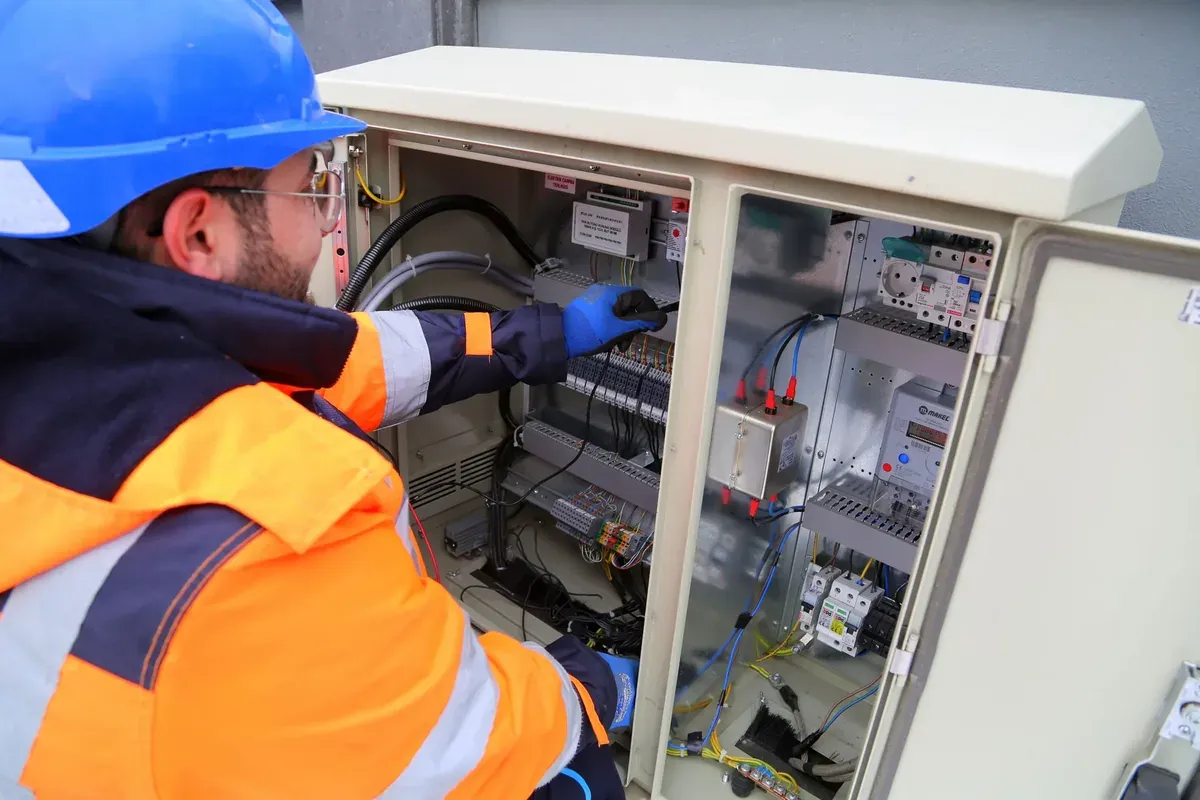
A GFCI that keeps tripping, or a disconnect that feels warm?
Bonding: the protection most owners never hear about
Bonding is not grounding, and it is the protection most hot tub owners have never heard of. It joins every metal part near the tub with copper, so they all hold the same potential and no voltage difference can appear between two surfaces you might touch at once. A tub fitted without a bonding check you remember is a reason to call on its own, because the gap is invisible until a fault proves it.
What gets bonded, and how the check runs, is a subject of its own. Our pool bonding and GFCI guide covers bonding and GFCI protection for pools and spas in full, including the metal parts that count and the signs that bonding is missing. Read it before the visit, and bring any questions it raises to the call.
Warning signs: stop using the tub and call
Some hot tub faults announce themselves, and every one of them means the same thing: stay out of the water and call. A GFCI that trips every time the tub runs. A disconnect that feels warm, or shows scorch marks. Buzzing or crackling from the disconnect or the panel. A burning smell near the tub, the disconnect, or the panel. An ozone-like smell, or underwater lights that flicker, look dull, or stop working. And a tingle when you touch the water or a metal rail — get out, stay clear, and call.
If you notice any of these, switch the tub off at the disconnect only if you can do so safely without touching water, and never get into the water to investigate. Never open the panel yourself to look — the main lugs stay energised even when individual breakers are off. For a fire or an injury, call 911 first. Our warm outlet guide and our panel buzzing guide cover what heat and buzzing mean elsewhere in the house, and the same rule applies at the tub: heat, smell, or sound means stop.

Buzzing, a burning smell, or lights that flicker under water? Stop and call.
Salt air, storms, and the Fort Pierce check
Fort Pierce weather reaches a hot tub's electrics first. Salt air corrodes outdoor disconnects and fittings, water finds poorly sealed connections, and sun bakes conduit until it cracks. On Hutchinson Island, where pool and spa circuits live in salt air year-round, the outdoor disconnect is where the visit starts. Our salt-air electrical corrosion guide explains how coastal air wears fittings down, and what the visit looks for.
After a storm, or any flooding around the tub, the rule is simple: wet equipment needs an inspection before it is used again, because damage is not always visible from outside the box. Do not touch a wet disconnect, do not reset its breaker, and do not run water near the circuit. Our electrical safety after flooding guide covers the same rule for the rest of the house. An annual inspection is worth keeping too — our how often to inspect guide sets out what it covers.
Plug-and-play tubs: smaller circuit, same rules
Not every tub is hardwired. Smaller plug-and-play tubs run on a 120-volt circuit, and they still need a circuit of their own with GFCI protection — a shared outlet, or an extension cord, is never the answer. The trade-off is heat: on many plug-and-play models the heater shuts off while the jets run on high, so the water cools during a long soak. If that trade-off starts to grate, the answer is a hardwired 240-volt circuit, planned on the call.
What the visit checks, and what to have ready
The visit checks the whole chain, in order: the circuit and its size against the spec sheet, the GFCI and its test, the disconnect and its position, the bonding, and the panel's spare capacity. Bring the tub's make and model, or a photo of the rating plate, the distance from the panel to the pad, and whether the tub is already delivered — fitting the electrics before delivery is the better order, so delivery day is a connection and a test. For island condos, bring any association rules that affect outdoor work. Our hot tub electrical hookup page covers the install, our Hutchinson Island area page covers the island, and the Fort Pierce Electric Pros homepage covers everything else we do.
Call (772) 218-3629 any time; we are open 24/7, and same-day service is available. With the make, the model, and the panel-to-pad distance in hand, the call ends with a clear scope and a written price.
Hot Tub Electrical Safety Fort Pierce | 24/7: frequently asked questions
Does a hot tub need its own circuit?
Yes. A hot tub needs a dedicated circuit of its own, sized from the maker's specification sheet — most full-size tubs run on a 240-volt circuit, commonly 40 to 60 amps. A shared circuit trips under load, starves the heater and pumps, and hides faults. Smaller plug-and-play tubs still need a dedicated, GFCI-protected circuit of their own.
What does the GFCI do, and why does it keep tripping?
The GFCI cuts power in a fraction of a second if current leaks through water, a person, or damaged insulation. Test it monthly with the test button. A GFCI that trips again and again is reporting a fault, not being a nuisance — usually moisture in a connection, a failing heater or pump, or damaged wiring. Stop resetting it and call; the fault needs finding, not overriding.
How far must the disconnect be from the tub?
The disconnect must sit within sight of the tub and at least five feet from its inside walls, so anyone can kill the power fast without reaching across the water. The exact spot is confirmed on the visit, because it depends on the tub's position, the wall or post it mounts on, and the wiring route. Know where it is before anyone gets in.
What is bonding, and why does my hot tub need it?
Bonding joins every metal part near the tub with copper, so they all hold the same potential and no voltage difference can appear between two surfaces you might touch at once. It is not the same as grounding. A tub fitted without a bonding check you remember is a reason to call on its own — our pool bonding and GFCI guide explains the check in full.
My hot tub lights flicker, or I smell something odd — is that urgent?
Yes. Underwater lights that flicker, look dull, or stop working, a pump that buzzes, or an ozone-like smell near the tub are all signs to stop. Switch the tub off at the disconnect, stay out of the water, and call — never get in to look at a light or a connection that may be live. A disconnect that feels warm, or a burning smell, is a same-day call.
What should I have ready when I call about a hot tub in Fort Pierce?
Your street and ZIP, the tub's make and model, or a photo of the rating plate, the distance from the panel to the pad, and whether the tub is already delivered. Tell us whether anything trips, feels warm, smells of burning, or buzzes, and whether the home is a house or a condo. With those answers, the call ends with a clear scope and a written price. Call (772) 218-3629, 24/7.
Ready to talk?