
Generator Installation in Lincoln Park, Fort Pierce
Generator installation Lincoln Park Fort Pierce starts with an inspection, not a size: in one of Fort Pierce's oldest-home neighbourhoods, ZIP 34945 and 34950, around Lincoln Park, Avenue D and Orange Avenue, the panel verdict comes before any generator is chosen.
Call Now to Speak to a Specialist
Open 24 hours a day, 7 days a week.
Generator installation Lincoln Park Fort Pierce is decided in order: inspection first, panel verdict second, wiring third, size last. Skip the order and the generator lands on a panel that cannot carry it or wiring that cannot feed it. This guide walks the four steps in that order, so the decision you make is the one the house can carry.
Inspection first: why a Lincoln Park generator starts at the panel
In one of Fort Pierce's oldest-home neighbourhoods, the generator decision follows the neighbourhood's own order: inspection first, panel decision second. The Lincoln Park area page states that order plainly, and a generator job follows it for the same reason — older homes hide their history inside walls and panels, and none of it should be guessed at. The inspection shows what the panel and wiring actually are, and only then does the size enter the conversation.
The signs that send a homeowner to the inspection first are the ones this neighbourhood shows most: breakers that trip when the air conditioner starts, lights that flicker or dim across several rooms, a panel that runs warm, a burning smell, or buzzing at the panel. Any one of those means test before you size. A generator chosen before the inspection is a size fitted to a guess, and the first outage is when the guess gets tested. Our electrical repair guide for Lincoln Park covers the fault pattern across these older homes.
The three panel verdicts — and the one that stops the job
Generator installation Lincoln Park Fort Pierce turns on the inspection, and the inspection ends in one of three verdicts. Verdict one: the panel has room and is sound, so the generator circuit goes in. Verdict two: the panel is full but the service is sound, so a subpanel beside the main panel gives the room the switch needs. Verdict three: the panel is obsolete or unsafe — a Federal Pacific Stab-Lok, a Zinsco, or a fuse box instead of breakers — so the panel is replaced before any generator work starts.
The third verdict is a stop condition, not a detail, and it is the one that separates an honest generator job from a risky one. A generator must never be sized onto a panel that has not passed that check, because the transfer switch, the generator circuits and the load the generator carries all sit on that panel. Our Federal Pacific versus Zinsco guide explains why those two brands are replace-first, and our Federal Pacific replacement and Zinsco replacement pages cover the work. A full panel is not a dead end either: our subpanel installation page covers the room-maker route, our panel upgrade page covers the replacement route, and our panel upgrade cost-factors guide lists what moves that quote.
A panel that is full, or one you no longer trust?
The older-home wiring constraint: which rooms the generator can back up
The second step is the wiring, and in Lincoln Park it is a constraint, not a formality. Wiring in these homes often predates modern kitchen and laundry loads, and rewiring decisions here are usually made room by room rather than all at once. So the backed-up circuit list is built the same way: the circuits the existing wiring can safely carry go on the list, and the rooms whose wiring cannot carry a backed-up load stay off it until their wiring is dealt with. Whole-home coverage the wiring cannot support is not promised.
That room-by-room list is what the inspection maps. The kitchen and laundry circuits are the ones to watch, because they carry the loads the original wiring was never sized for, and GFCI protection is checked room by room in the same visit — our GFCI outlet installation page covers that protection. Our signs a house needs rewiring guide explains the warning signs, and the inspection report says which rooms are ready for backup power and which need wiring work first. Where full rewiring is the answer, our whole-house rewiring page covers the scope.
Sizing strategy, chosen only after steps one and two
Only after the panel verdict and the wiring list comes the sizing strategy, and there are three. An essentials-only subpanel feeds just the must-run circuits and takes the smaller generator. A managed whole-home setup feeds the whole panel and sheds the big comfort loads in a set order when the generator nears capacity. A full whole-home setup carries everything with no shedding and takes the largest generator. The strategy is picked first; the size follows from it. Our 100-amp versus 200-amp guide explains the service sizes. Our home generator installation guide covers the whole-home scope.
With the strategy chosen, the size follows one rule: add the running watts of every circuit the strategy covers, then add the single largest starting surge on top of that total. A motor draws two to three times its running watts when it starts, and in a Fort Pierce home the air conditioner compressor is usually the largest surge there is — a generator sized on running watts alone stalls the first time the compressor kicks in. Square footage never enters the sum, because it says nothing about what runs inside, and the panel rating never enters it either, because it says what the house can carry, not what the generator must produce. Load-management modules are the relays that watch the generator's output and temporarily shed a designated large load — a second air conditioner, an electric water heater, an EV charger, a dryer — when demand nears capacity, then restore it once the peak passes; the order they shed in is the plan, and it exists because two motors starting at the same instant is what the modules prevent. Leave headroom for future loads, so the unit is not pinned at capacity on the day it is installed. Our sizing guide works through the method. Our generator installation service page and Generac installation page cover the fitting.
Not sure which sizing strategy fits your home?
The transfer switch, and the portable question
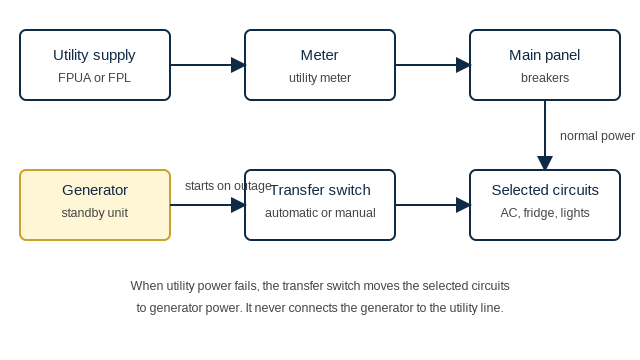
The transfer switch is the part that moves the house between grid power and generator power, and it comes in two shapes: an automatic switch that starts the generator and transfers the load itself, or a manual switch that waits for the homeowner. A service-rated switch feeds the whole home; an essential-circuits subpanel switch feeds only the backed-up circuits. Our transfer switch versus interlock kit guide explains why power goes through a proper switch, never backfed through a household outlet, and our automatic transfer switch page covers the fitting.
Portable or standby is a one-paragraph question for a Lincoln Park home, because the inspection has already answered most of it. A portable unit is carried out, fuelled by hand and started by hand, and it feeds the house through a manual switch or an interlock kit — louder, and only as steady as the person running it. A standby unit starts itself when the grid fails and sits in a sound-dampening enclosure on its pad. Our portable versus standby guide covers the comparison in full, and our battery versus generator post covers the stored-energy alternative for a home that would rather not run a generator at all.
Placement and neighbours on a close-set older street
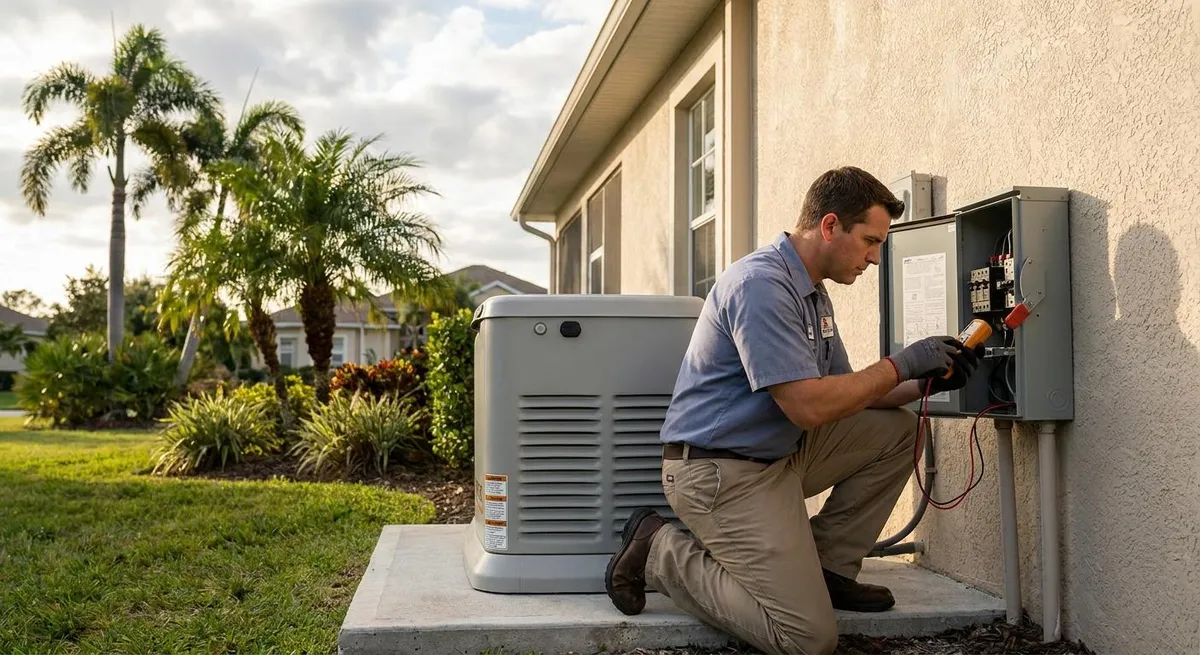
Where the unit sits is a visit decision, not a page decision. Lincoln Park streets are close-set, so the questions matter more here than on a wide subdivision lot: how far the unit stands from windows, doors and air intakes, how far from the property line, which way the exhaust points, and how much sound reaches the neighbours. Those are questions to confirm for the address, in general code framings only — no Fort Pierce setback or noise figure is claimed here.
The safety rules do not change with the neighbourhood. A generator never runs indoors or in a garage — the exhaust has nowhere safe to go, and the risk is the same on every street. Backfeeding through a household outlet is dangerous and illegal, because it can put power onto lines that workers believe are dead. And the panel is never opened by the homeowner: the visit reads the panel, the bus and the connections, and the inspection is the electrician's job. Our portable generator safety guide covers the same two rules for a portable set.
Wondering where a standby unit would sit on your lot?
Fuel, permits, cost factors — and what to have ready when you call
Fuel is the second question the visit settles, after the panel and the wiring. A Lincoln Park home runs a standby generator on natural gas from the street or on propane kept in a tank on the property — and which one fits is decided by the address, not the neighbourhood: whether a gas line reaches the house, and whether the lot has room for a tank. Gas from the street keeps flowing while the supply holds. Propane is limited by the tank, so the runtime question is really a tank-size question. Our propane and gas line guide covers the line and tank questions.
The permit and inspection step is a question to confirm for your address. Panel and switch work usually needs a permit and inspection, and what applies depends on the job, so the visit settles it for your home. Cost is a cost-factors question, not a price question, and this post gives no dollar figures: the job type, the panel and wiring condition, the access, the fuel line or tank, the pad, and any permit step all shape the scope. Our Generac cost-factors guide lists the factors without inventing a price, and our guide to choosing a generator installer covers what a quote should show.
One note on why this post exists now. Florida-wide, generator queries have been rising on Google Trends: "generac generator cost including installation" rose 2,800% in Florida over the past 90 days, as relative interest, not a search volume, with backup and standby installation queries rising alongside it. Fort Pierce itself does not appear in the city-level lists, so no Fort Pierce rank is claimed here — the neighbourhood combination is the reason for this post, not a city trend.
Generator installation Lincoln Park Fort Pierce is settled one decision at a time — the inspection, the panel verdict, the wiring list, the strategy, the surge, the fuel — each made on the call, in plain language, with the price held for the visit. Call (772) 218-3629 any time; we are open 24/7. We are licensed and insured, with 23 years of experience and Master Electrician Certification. Our best time to install guide covers timing, and our generator maintenance guide covers the exercise and battery routine. The same family of posts covers St. Lucie Village, Lakewood Park, Hutchinson Island, Fort Pierce South, White City, Waterstone and Maravilla. Or start at the Fort Pierce Electric Pros homepage.
Generator Installation in Lincoln Park, Fort Pierce: frequently asked questions
Why does a Lincoln Park generator start with an inspection?
Because the inspection shows what the panel and wiring actually are, and in one of Fort Pierce's oldest-home neighbourhoods that is never safe to guess. Lincoln Park homes were wired to the standards of their time, and those standards changed many times since. The inspection report is the basis for the panel verdict, the backed-up circuit list and the size — and it protects you from paying for a generator the house cannot carry.
What are the three panel verdicts?
Room and sound, full but sound, or obsolete and unsafe. A panel with room that is sound takes the generator circuit. A panel that is full but whose service is sound gets a subpanel beside it for the room the switch needs. A panel that is obsolete or unsafe — Federal Pacific, Zinsco or a fuse box — is replaced before any generator work starts. A generator must never be sized onto a panel that has not passed that check.
Can my old wiring carry a whole-home generator?
Only the inspection can say, and the honest answer is often not yet. Wiring in Lincoln Park homes often predates modern kitchen and laundry loads, so the backed-up list is built room by room from what the existing wiring can safely carry. Rooms whose wiring cannot carry a backed-up load stay off the list until their wiring is dealt with. Whole-home coverage the wiring cannot support is not promised.
Essentials-only subpanel, managed whole-home, or full whole-home — which fits my home?
The panel verdict and the wiring list decide it, not the catalogue. An essentials-only subpanel backs up just the must-run circuits, so it takes the smaller generator. A managed whole-home setup backs up the whole panel and sheds the big comfort loads in a set order when the generator nears capacity. A full whole-home setup carries every load at once and takes the largest generator. Size follows the strategy, never the other way round.
Where does a standby generator go on a close-set older street?
The visit settles it, lot by lot. On a close-set older street the questions are clearances from windows, doors and air intakes, the distance from the property line, which way the exhaust points, and how much sound reaches the neighbours — all confirmed for the address, with no Fort Pierce figure claimed here. The two rules that never bend are that a generator never runs indoors or in a garage, and power always goes through a proper transfer switch.
Natural gas or propane — and what sets the cost?
That is a question for the address. Where a gas line reaches the home, natural gas keeps flowing while the supply holds; where it does not, propane stored on site is the option, and runtime is limited by tank size. What moves the scope is the job type, the panel and wiring condition, the access, the fuel line or tank, the pad, and a permit step. No dollar figure is given here — the price is held for the call.
Ready to talk?