
Generator Installation in Fort Pierce North, Fort Pierce
Generator installation Fort Pierce North Fort Pierce starts with the stack on the panel, not the catalogue: in ZIPs 34946 and 34982, near Lakewood Park and St. Lucie Village, homes run air conditioning, a Level 2 EV charger and garage circuits, so the generator decision is a load-management decision first.
Call Now to Speak to a Specialist
Open 24 hours a day, 7 days a week.
Generator installation Fort Pierce North Fort Pierce is decided by a load list before a size: list what must stay on in an outage, face the air-conditioning compressor, the EV charger and the garage circuits as three big loads, check whether the panel can carry them together, and only then choose the generator, the transfer switch and the priority plan.
Step one: the stacked-loads inventory
A Fort Pierce North panel does three big jobs at once: central air conditioning through the warm months, a Level 2 EV charger drawing a steady 40–50 amps whenever the car charges, and garage workshop circuits — tools, a second refrigerator, a freezer — that switch on without warning. Together they are the stack.
The inventory starts with what must stay on: lights, refrigerator, air handler, water heater and communications gear. Then the three big loads are faced one at a time. The central air conditioning compressor needs its running watts and its starting surge counted together, since a starting motor draws several times its running watts. The EV charger is a 40–50A continuous load that adds nothing needed while the power is out — the car can wait. The garage and workshop circuits are intermittent heavy loads that start hard, run briefly and stop, and they must be named, not assumed away.
The Fort Pierce North area page describes this northern belt; our Fort Pierce North EV charger post and our EV charger installation service cover the charger circuit. The inventory is the household's list, made before any size is discussed.
Step two: the three-tier priority plan
With the inventory in hand, every circuit gets a tier, and the tier decides what the generator does. Tier 1 never sheds: lights, refrigerator, air handler, water heater, communications. Tier 2 stages: the central air conditioning compressor, brought back after the generator stabilises and cycled as capacity allows, never starting with another motor. Tier 3 locks out: the EV charger, the garage and workshop heavy circuits, the electric dryer — never run on generator power at all.
A staged load comes back when there is room for it; a locked-out load never comes back. The air conditioner earns its staged place because a Fort Pierce home without cooling through a long outage cannot be lived in — but on the generator's terms, one motor at a time, with the starting surge counted first. The EV charger earns its lockout because charging a car during an outage spends generator capacity on a job that can wait. Load-shedding modules — Smart Management Modules — make the plan run itself, dropping lower-priority large loads when demand threatens supply and restoring them in staged priority order. Our Maravilla generator post covers the shed order.
The plan belongs in writing before the quote is agreed. Generator load management in Fort Pierce North is a written plan first.
Three big loads on one panel?
Step three: the panel check — capacity and condition, asked together
With the tiers written down, the next question is the panel, asked two ways. Can it carry the stacked loads all at once? And is it still in good condition — corrosion on the connections, heat damage on the bus, a full breaker row, an obsolete brand? One failed question is enough to hold the job up: the generator inherits the panel's weakness either way.
A full panel changes the transfer decision itself. An interlock kit needs two available breaker spaces and a compatible panel; a transfer switch works with virtually any main panel, including an older or full one. A Federal Pacific, Zinsco or fuse-box panel is a replace-first stop — no generator work starts on one. The three panel verdicts — repair, subpanel, replace — are set out in our Lincoln Park generator post. Our Fort Pierce North breaker post covers the breaker-diagnosis ground, and our panel upgrade, subpanel installation and automatic transfer switch installation pages cover what follows.
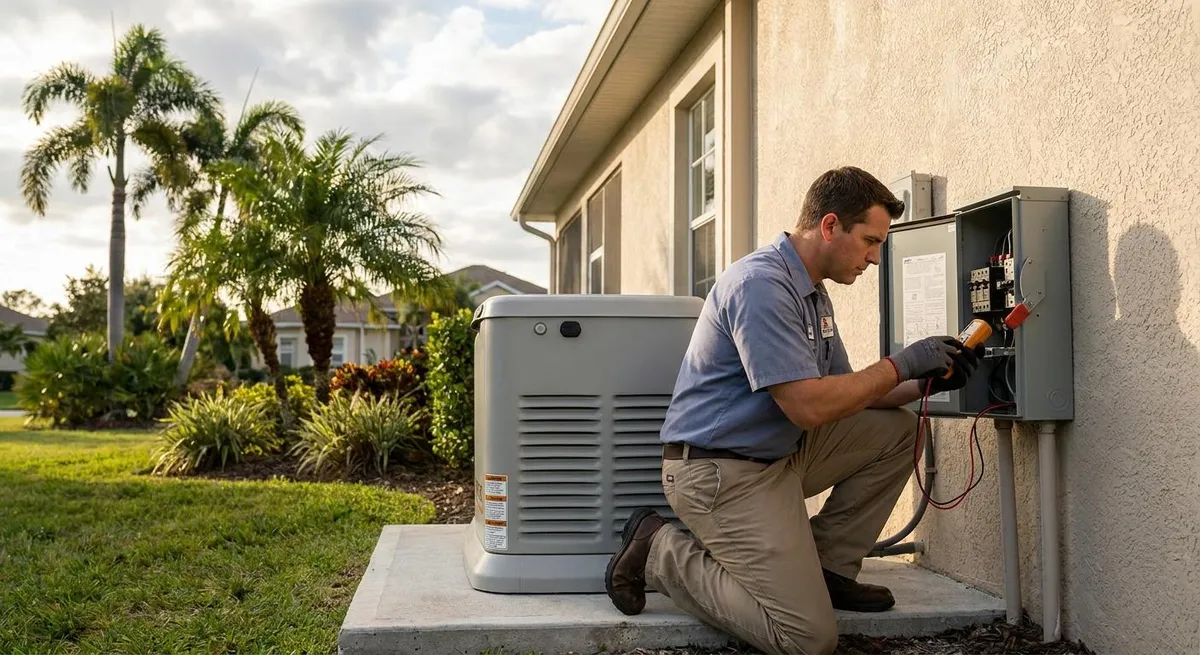
The panel check is the visit's fact-finding step: brand and size, spare spaces, service size, and the condition of the bus and breakers. Those facts, not a guess, decide the hardware and the size.
Step four: the transfer decision, driven by the stacked loads
The transfer decision is where the stacked loads stop being a detail and start being the swing factor. Whole-panel transfer moves everything the panel feeds onto the generator, with load management holding the EV charger and garage loads back. Selected-circuit transfer moves only the chosen circuits onto a smaller panel, and the EV charger and garage circuits sit outside it. Putting the stacked loads on backup needs a bigger generator or a stricter shed plan than leaving them off. An automatic transfer switch in Fort Pierce North is chosen for the stacked loads first.
There is no wrong answer, only a mismatch to avoid: a whole-panel switch with a generator too small for the stacked loads, or a selected-circuit switch that leaves a covered circuit out. The switch itself is what keeps generator power from backfeeding the grid. A double-male cord into an outlet is never the answer — the transfer switch is the only safe path, and the panel stays the electrician's job. Our transfer switch versus interlock kit guide and our Waterstone generator post cover the switch ground and the readiness plan. A whole house generator installation in Fort Pierce North is a whole-panel decision.
Whole-panel or selected-circuit?
Step five: sizing by what stays on, not by square footage
That is how generator installation Fort Pierce North Fort Pierce is sized: from the load list, never from the floor plan. Add the running watts of every circuit the plan keeps on, then add the starting watts of the largest motor starting while the others run — and the central air conditioning compressor's starting surge is part of that total. The generator must exceed the total starting load of the circuits running at once, or it stalls the first time two big motors start together.
Square footage never enters the sum — it says nothing about what runs inside the house — and neither does the panel rating. Leave headroom for the loads that come later. Load-shedding modules stage big loads back in priority order — that is how a sensibly sized generator survives the peaks. Generator load shedding in Fort Pierce North keeps a right-sized unit from tripping. Our sizing guide, our home generator installation guide and our generator installation service page cover the method, the scope and the fitting. A standby generator installation in Fort Pierce North is sized this same way — from the list, never from the floor plan.
Step six: fuel, siting and storm-season readiness, by link
Fuel is the sister posts' ground, not this post's: whether the gas line and meter are sized for the unit is settled on the visit; the fuel plan is in our St. Lucie Village, Lakewood Park and Waterstone generator posts. Our propane and gas line guide covers the line and tank. A generator never runs indoors or in an enclosed space, whatever the fuel.
Siting is the Hutchinson Island generator post's ground: salt air, water and the pad are its subject, and the same questions apply here. Placement is settled on the visit, for the address. Storm-season readiness is the surge posts' ground: surge protection at the panel works best when the panel, the grounding and the outdoor disconnects are sound. The Fort Pierce North area page carries the surge section; our whole-house surge protection guide, surge protection versus power strips guide and whole-house surge protection service cover the surge ground. And the same decision in an older Downtown home, where small lots and older panels set the order, is in our generator installation Downtown Fort Pierce post.
Want the three-tier plan for your panel?
Why this post, why now: what the trends show
Florida interest in generator installation ran low and steady through the second half of November — a sustained low run from November 4 to 17 at 20 to 41, ending on a partial day at 64. That is relative interest on a 0–100 scale, not a count of searches; November 18 is a partial day, so the final figure is read with caution. Over the past twelve months, Florida's rising queries were led by home generator installation near me, up 250 percent, with home generator installation, standby generator installation and backup generator installation up 70, 70 and 60 percent.
The West Palm Beach–Ft. Pierce metro ranked third of ten Florida metros over the past ninety days and fourth of ten over the past twelve months. That is metro strength, not Fort Pierce city evidence: Fort Pierce appears in none of the generator city views. The question households are asking is the home generator installation question — a backup generator installation in Fort Pierce North is the question this post answers.
Cost factors — and what to have ready when you call
Cost is a cost-factors question, not a price question, and this post gives no dollar figures: the job type, the panel and wiring condition, the access, the fuel line or tank, the pad, and any permit step all shape the scope. Our Generac and panel upgrade cost-factors guides list the factors without inventing a price. A Generac generator installation in Fort Pierce North is priced on the visit.
Have five things ready: the street and ZIP — 34946, 34950 or 34982 — reached from US 1 or I-95 Exit 126; the panel's brand and size; the load list, with the air conditioner, the EV charger and the garage circuits already sorted into stage, lockout or stay-on; and whether the home has natural gas or needs a propane tank. Timing, quotes, maintenance, inspection and hiring are covered by our best time to install guide, our guide to choosing a generator installer, our generator maintenance guide, our inspection cadence guide and our licensed electrician guide. A search for generator installation companies in Fort Pierce North should end with a written plan and price.
Generator installation Fort Pierce North Fort Pierce comes down to seven decisions: inventory, tiers, panel, transfer, sizing, fuel, siting and readiness. Each one is settled on the call, in plain language. Call (772) 218-3629 whenever the question comes up — the line is open 24/7. We bring 23 years of experience and Master Electrician Certification. The same family of posts covers Hutchinson Island, Lincoln Park, Maravilla, Fort Pierce South, Waterstone, Lakewood Park, St. Lucie Village, White City and South Beach. Or start at the Fort Pierce Electric Pros homepage, and for the repair side, see our Fort Pierce North electrical repair post and our portable versus standby guide.
Generator Installation in Fort Pierce North, Fort Pierce: frequently asked questions
Why does a Fort Pierce North generator plan start with the stacked loads?
Because three big 240-volt loads already share one panel here: central air conditioning, a Level 2 EV charger and the garage and workshop circuits. Each behaves differently in an outage — the compressor needs its starting surge counted, and the charger adds nothing the household needs.
What are the three tiers in the priority plan?
Tier 1 never sheds: lights, refrigerator, air handler, water heater and communications — the circuits that keep the house livable. Tier 2 stages: the air conditioning compressor, brought back after the generator stabilises and cycled as capacity allows, never starting with another motor. Tier 3 locks out: the EV charger, the garage and workshop circuits and the electric dryer, set to never run on generator power. The written plan comes before the quote is agreed.
How does a full panel change the transfer decision?
An interlock kit needs two available breaker spaces and a compatible panel, so a full panel rules it out. A transfer switch works with virtually any main panel, so the panel's condition decides the hardware. A Federal Pacific, Zinsco or fuse-box panel is a replace-first stop — no generator work starts on one. The three panel verdicts — repair, subpanel, replace — are set out in the Lincoln Park generator post.
Whole-panel or selected-circuit transfer for a stacked-loads home?
Whole-panel transfer moves everything the panel feeds onto the generator, with load management holding the EV charger and garage loads back. Selected-circuit transfer moves only the chosen circuits onto a smaller panel, and the EV charger and garage circuits sit outside it. Putting the stacked loads on backup needs a bigger generator or a stricter shed plan than leaving them off.
How is a Fort Pierce North generator sized?
From the list of what stays on, not from square footage. Add the running watts of every circuit the plan keeps on, then add the starting watts of the largest motor starting while the others run — the central air conditioning compressor's starting surge included. The generator must exceed that total. Load-shedding modules stage big loads back in priority order instead of letting them start together.
What shapes the cost, and is a price given here?
This post gives no dollar figure at all — the exact price is held for the call. The scope is shaped by the job type, the condition of the panel and wiring, the access, the fuel line or tank, the pad, and any permit step needed. Our Generac and panel upgrade cost-factors guides list those factors without inventing a price.
Ready to talk?